
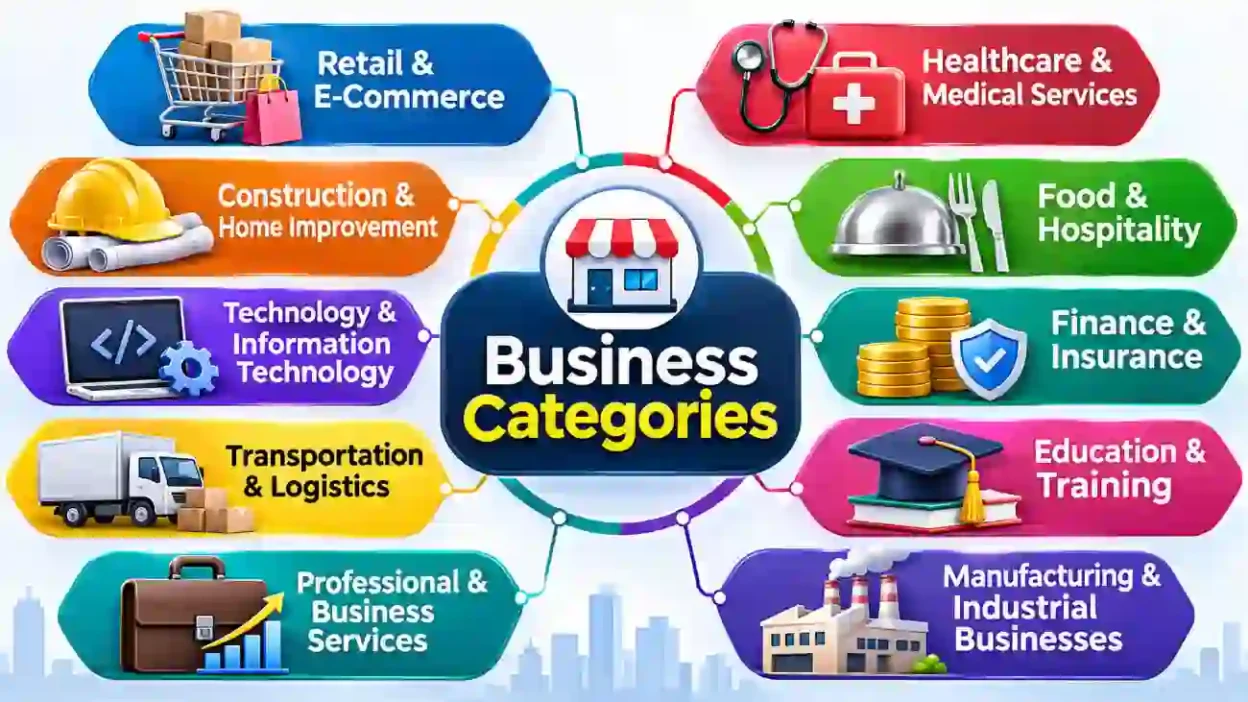
Business categories are groups used to classify companies based on the products they sell, services they provide, or industries they operate in. Common business categories in the USA include retail, healthcare, construction, technology, manufacturing, education, transportation, finance, and professional services.
Key Takeaways
- Business categories organize companies according to their products, services, and main activities.
- Common categories include retail, healthcare, construction, technology, finance, and hospitality.
- The NAICS system helps classify businesses across the United States.
- Choosing the correct business category can support registration, marketing, licensing, and tax reporting.
- Some companies belong to multiple categories depending on the services they offer.
Business Categories
Introduction
Every business belongs to one or more industries based on what it sells, produces, or provides. These classifications are known as business categories. They help customers, government agencies, investors, and business owners understand what a company does.
When starting a company, registering a business, or creating an online listing, you may need to select a suitable category. Choosing the right one makes it easier for people to find your services and helps keep business information organized.
However, finding the correct classification is not always simple. A company might offer several services or operate in more than one industry. For example, a company that sells furniture online and offers interior design services could fit into both retail and professional services.
This guide explains the most common business categories in the USA, how they work, and how to choose the right one for your company.
What Do Business Categories Mean?
Business categories are classifications that group companies according to their primary activities, products, or services. They make it easier to identify what a business does and which industry it belongs to.
For example, a restaurant belongs to the food service industry, while a construction contractor operates in the construction industry.
Businesses use these classifications for several purposes, including:
- Business registration: Identifying the company’s main activities.
- Marketing: Helping customers find relevant products and services.
- Industry research: Comparing companies operating in similar markets.
- Tax reporting: Identifying business activities for applicable reporting requirements.
- Licensing: Determining which industry-specific permits or requirements may apply.
In the United States, one important classification system is the North American Industry Classification System (NAICS). Government agencies use NAICS codes to organize businesses according to their economic activities.
Why Use Different Business Categories?
Business categories make it easier to understand the commercial world. Without clear classifications, comparing companies, researching industries, and finding specific services would be much harder.
Here are some important benefits:
- Better organization: Groups similar companies into recognizable industries.
- Easier business searches: Helps customers find relevant companies.
- Improved marketing: Allows businesses to target specific audiences.
- Industry research: Makes market trends and competition easier to study.
- Business planning: Helps entrepreneurs understand where their companies fit.
- Accurate classification: Supports appropriate government and industry reporting.
For example, someone looking for a home renovation contractor can narrow their search to construction businesses instead of browsing unrelated companies.
10 Best Business Categories in the USA
The United States has thousands of business activities, but most companies fall into several broad industry groups. Below are 10 major business categories, along with examples and explanations.
1. Retail and E-Commerce
Retail businesses sell products directly to consumers for personal or household use. They operate through physical stores, websites, online marketplaces, or a combination of these channels.
E-commerce has made this category especially popular because entrepreneurs can sell products without opening a traditional storefront.
Meaning
Retail includes businesses that purchase or produce goods and sell them to individual customers. E-commerce refers specifically to buying and selling products through online platforms.
Best For
- Retail businesses
- Online stores
- Product-based startups
- Consumer brands
Example 1
A clothing store sells shirts, jeans, shoes, and accessories to customers through a physical location.
Example 2
An online business sells home decorations and kitchen accessories through its website.
Quick Tip
If your company sells physical products directly to customers, retail is usually a suitable broad category.
2. Healthcare and Medical Services
Healthcare businesses provide medical treatment, preventive care, diagnostic services, and other health-related support.
This industry includes hospitals, dental offices, medical laboratories, pharmacies, and independent healthcare professionals.
Meaning
Healthcare covers businesses and organizations that help people maintain, improve, or restore their health.
Best For
- Medical practices
- Dental clinics
- Healthcare providers
- Diagnostic centers
Example 1
A dental clinic provides routine checkups, teeth cleaning, and restorative dental treatments.
Example 2
A medical laboratory performs blood tests and provides diagnostic results to healthcare professionals.
Quick Tip
Healthcare businesses may require professional credentials, special permits, and compliance with industry regulations.
3. Construction and Home Improvement
Construction businesses build, repair, renovate, and maintain residential and commercial properties.
This category includes general contractors, electricians, plumbers, roofers, painters, and remodeling companies.
Meaning
Construction covers companies involved in building projects, property improvements, structural repairs, and specialized installation services.
Best For
- General contractors
- Home improvement companies
- Roofing businesses
- Plumbing and electrical services
Example 1
A remodeling company renovates kitchens, bathrooms, and living spaces for homeowners.
Example 2
A construction contractor builds commercial offices and residential properties.
Quick Tip
Choose a specific construction classification when your company focuses on a specialized service, such as roofing or electrical installation.
4. Food and Hospitality
Food and hospitality businesses serve meals, provide accommodation, and offer experiences related to travel and leisure.
Restaurants, cafes, catering companies, hotels, bakeries, and food delivery services belong to this broad category.
Meaning
This category includes companies that prepare food, serve customers, provide lodging, or deliver hospitality-related experiences.
Best For
- Restaurants
- Hotels
- Cafes
- Catering companies
- Food businesses
Example 1
A family-owned restaurant prepares breakfast, lunch, and dinner for local customers.
Example 2
A catering company provides meals and refreshments for weddings and corporate events.
Quick Tip
A restaurant and a packaged food manufacturer may both operate in the food industry, but they belong to different specific business classifications.
5. Technology and Information Technology
Technology businesses develop, sell, and maintain digital products, software, and technical services.
This industry has expanded as companies increasingly depend on websites, cloud platforms, cybersecurity, and digital tools.
Meaning
Technology includes companies that create or support software, hardware, information systems, and digital infrastructure.
Best For
- Software developers
- IT consultants
- Cybersecurity companies
- SaaS businesses
- Technology startups
Example 1
A software company develops project management applications for businesses.
Example 2
An IT support company helps small businesses maintain computers, networks, and cloud systems.
Quick Tip
Identify your company’s main activity. Software publishing, IT consulting, and computer repair are different business activities.
6. Finance and Insurance
Finance and insurance businesses help individuals and organizations manage money, protect assets, and handle financial risks.
Banks, insurance agencies, investment firms, accounting services, and financial consulting companies operate in this industry.
Meaning
This category covers businesses that provide financial products, money management, insurance coverage, and related professional services.
Best For
- Financial advisors
- Insurance agencies
- Accounting firms
- Banking institutions
- Investment services
Example 1
An insurance agency helps customers compare auto, home, and business insurance policies.
Example 2
An accounting firm prepares financial statements and provides tax preparation services.
Quick Tip
Financial and insurance businesses should check applicable federal and state licensing requirements before offering regulated services.
7. Transportation and Logistics
Transportation and logistics companies move people, products, and materials from one location to another.
This industry includes trucking companies, delivery services, freight brokers, moving companies, and passenger transportation providers.
Meaning
Transportation focuses on moving goods or people, while logistics also covers planning, storage, distribution, and supply chain operations.
Best For
- Delivery companies
- Trucking businesses
- Moving services
- Freight companies
- Logistics providers
Example 1
A trucking company transports construction materials between suppliers and building sites.
Example 2
A local delivery business transports packages from warehouses to customers.
Quick Tip
If your company mainly stores and distributes products rather than transporting them, a warehousing or storage classification may be more accurate.
8. Education and Training
Education businesses provide academic instruction, professional development, tutoring, and skill-based training.
They can operate through traditional classrooms, private lessons, online courses, or corporate training programs.
Meaning
This category includes organizations that help students and professionals develop knowledge, skills, and qualifications.
Best For
- Tutoring centers
- Online education platforms
- Training companies
- Language schools
- Educational consultants
Example 1
A tutoring center provides mathematics and reading lessons to elementary and high school students.
Example 2
An online education company offers courses in digital marketing and web development.
Quick Tip
Check whether your business provides formal education, professional training, or informal instruction because these activities may have different classifications.
9. Professional and Business Services
Professional and business service companies provide specialized knowledge, advice, and operational support to individuals and organizations.
Examples include marketing agencies, law firms, consulting companies, graphic design studios, and management services.
Meaning
This category covers businesses that sell expertise, professional knowledge, or specialized services instead of physical products.
Best For
- Marketing agencies
- Consulting firms
- Legal services
- Design studios
- Business support companies
Example 1
A digital marketing agency manages search engine optimization, paid advertising, and content marketing campaigns.
Example 2
A business consulting firm helps companies improve operations and develop growth strategies.
Quick Tip
Describe your primary service clearly. Marketing, management consulting, and legal services have separate industry classifications.
10. Manufacturing and Industrial Businesses
Manufacturing businesses transform raw materials, components, or other materials into finished products.
They supply goods to retailers, wholesalers, other manufacturers, and sometimes directly to consumers.
Meaning
This category includes companies that produce physical goods through industrial processes, assembly, fabrication, and specialized production.
Best For
- Furniture manufacturers
- Food manufacturers
- Clothing factories
- Industrial equipment producers
- Product manufacturers
Example 1
A furniture manufacturing company produces wooden tables, chairs, and cabinets for retailers.
Example 2
A food production facility packages snacks and distributes them to grocery stores.
Quick Tip
A company that manufactures products is generally classified differently from a retailer that simply purchases and resells those products.
Business Categories Comparison Table
The following table provides a quick comparison of the 10 major business categories.
| Alternative | Best Used In | Tone |
|---|---|---|
| Retail and E-Commerce | Online stores and shops | Commercial |
| Healthcare and Medical Services | Clinics and hospitals | Professional |
| Construction and Home Improvement | Contractors and renovation firms | Industrial |
| Food and Hospitality | Restaurants and hotels | Service-focused |
| Technology and IT | Software and tech companies | Technical |
| Finance and Insurance | Banks and insurance agencies | Financial |
| Transportation and Logistics | Delivery and freight companies | Operational |
| Education and Training | Schools and training centers | Educational |
| Professional and Business Services | Agencies and consultants | Professional |
| Manufacturing and Industrial Businesses | Factories and producers | Industrial |
Common Mistakes When Choosing Business Categories
Selecting the wrong business category can create confusion in business listings, registration documents, and industry research. Avoid these five common mistakes.
1. Choosing a category that is too broad
Selecting a general category when a specific classification is available may make it harder for customers and organizations to understand your services. For example, a roofing company should consider a roofing-related classification rather than relying only on the general construction label.
2. Confusing products with services
A business that sells computers is different from one that repairs them. Although both operate in the technology industry, their primary business activities are not the same.
3. Ignoring the main business activity
Some companies offer several products and services. However, their primary classification should generally reflect their main activity, especially when selecting an official industry code.
4. Using outdated industry information
Business classification systems can change over time. Always check the latest official classification details before submitting registration or reporting information.
5. Assuming every platform uses the same categories
Government agencies, online directories, payment providers, and marketing platforms may use different classification systems. A category that works for one platform may not be available on another.
Frequently Asked Questions
1. What are the main business categories in the USA?
The main business categories in the USA include retail, healthcare, construction, technology, manufacturing, finance, transportation, education, hospitality, and professional services. These broad groups cover many smaller industries and specialized business activities.
2. How many business categories are there?
There is no single fixed number of business categories because different organizations use different classification systems. The NAICS system provides hundreds of detailed industry classifications across 20 broad sectors, allowing government agencies and researchers to organize economic activities.
3. What are the 20 NAICS industry sectors?
The 20 NAICS sectors cover agriculture, mining, utilities, construction, manufacturing, wholesale trade, retail trade, transportation, information, finance, real estate, professional services, management, administrative services, education, healthcare, arts and entertainment, accommodation and food services, other services, and public administration.
4. How do I find the right business category?
Start by identifying the main product or service your company provides. Then compare your business activities with the available categories in the relevant classification system. If you need an official NAICS classification, review the U.S. Census Bureau’s NAICS resources to identify the most appropriate industry code.
5. What is the difference between a business category and a business type?
A business category describes the industry or activity a company operates in, such as healthcare or retail. A business type often describes its ownership or legal structure, such as a sole proprietorship, partnership, LLC, or corporation. These terms serve different purposes.
6. What business category should I choose for an LLC?
An LLC should select a category based on its actual business activities, not simply because it is an LLC. For example, a cleaning company may belong to the cleaning services industry, while an online clothing store may fall under retail trade. The appropriate classification depends on the purpose of the form or registration.
7. Are business categories and NAICS codes the same?
No. Business categories are general industry groupings, while NAICS codes are specific numerical identifiers used to classify economic activities. For example, construction is a broad category, while a particular NAICS code can identify a specific type of construction activity.
8. Can one business belong to multiple categories?
Yes. A company can operate in several industries if it provides different products or services. For example, a company that sells furniture, offers interior design, and provides installation services may have activities associated with retail, professional services, and construction-related work. Its official classification depends on the applicable reporting rules and primary activity.
Conclusion
Understanding business categories helps entrepreneurs, customers, and organizations identify what companies do and where they operate. From retail and healthcare to construction, technology, and manufacturing, each category represents a different part of the American economy.
Choosing the right classification depends on your company’s main activities. A business that sells products may fit into retail, while a company that provides specialized expertise may belong to professional services. Some businesses also operate across multiple industries.
If you need a category for business registration, online listings, market research, or government reporting, check the specific classification system being used. For official industry classification in the United States, the NAICS system is a useful starting point.