
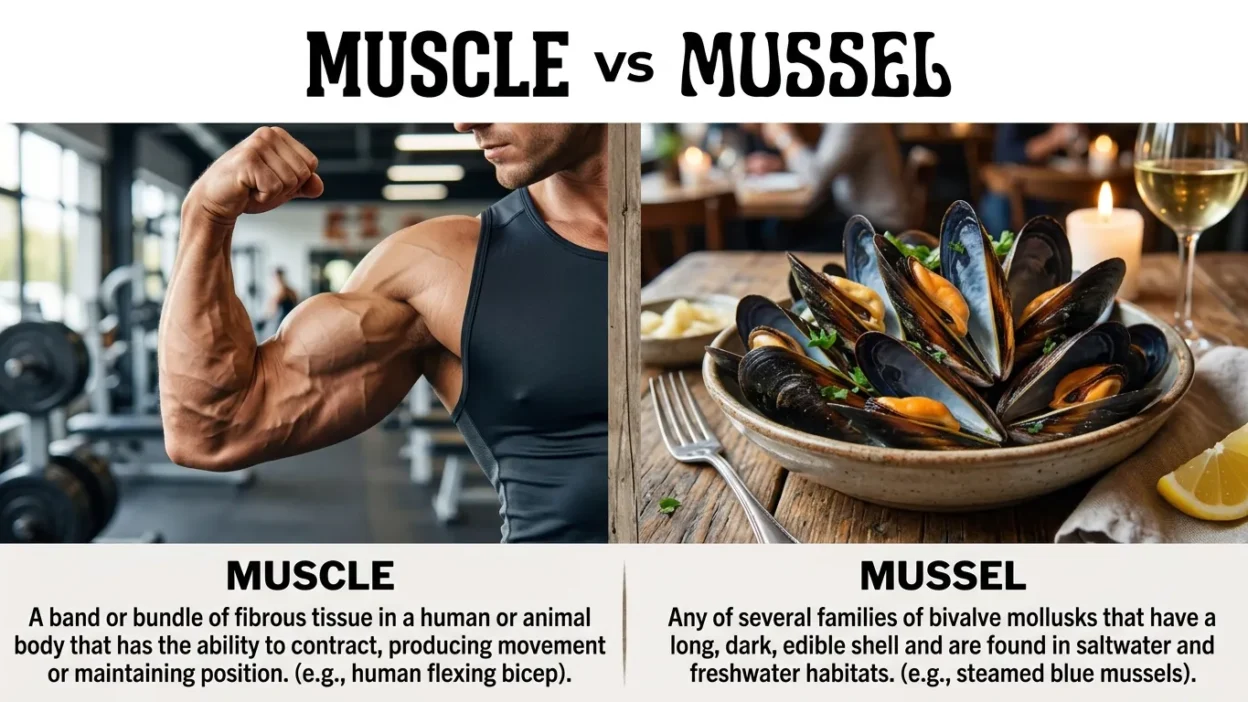
Have you ever typed a word and suddenly wondered, “Wait… is that spelled right?” That happened to me when I first saw muscle vs mussel. They look almost identical and sound very similar, but their meanings are completely different.
One is connected to the human body, while the other is a type of shellfish. This common spelling mix-up can be especially confusing when writing captions, messages, school assignments, recipes, or social media posts. The good news is that remembering the difference is easy once you know what each word means.
Quick Answer: Muscle means a body tissue that helps you move, while mussel means an edible shellfish. They are pronounced similarly but have different meanings and spellings.
🧠 What Does Muscle vs Mussel Mean?
Muscle and mussel are two different English words that are often confused because they sound nearly the same.
What Does Muscle Mean?
A muscle is a part of the body made of tissue that contracts and relaxes to create movement. Muscles help you walk, lift objects, smile, run, and perform countless other actions.
Example:
- I have been working out to build stronger muscles.
The word muscle can also be used figuratively to describe physical strength or power.
Example:
- The company used its financial muscle to expand quickly.
What Does Mussel Mean?
A mussel is a small aquatic animal with a hard shell. Mussels live in freshwater or saltwater and are commonly eaten as seafood.
Example:
- We ordered steamed mussels for dinner.
So, if you are talking about your arms, legs, chest, or physical strength, use muscle. If you are talking about seafood, use mussel.
In short: Muscle vs Mussel = body tissue vs shellfish = strength and movement vs seafood.
📱 Where Is Muscle vs Mussel Commonly Used?
These words are not really texting slang. They are standard English vocabulary and can appear in many different situations.
- 💪 Muscle: Fitness conversations, gym posts, sports, health discussions, and everyday speech.
- 🦪 Mussel: Restaurant menus, cooking conversations, seafood recipes, fishing, and marine biology.
- 📱 Texting: Both words can appear in casual messages.
- 📸 Instagram/TikTok: Muscle is common in workout captions, while mussel may appear in food content.
- 🎮 Gaming: Muscle may describe a strong character or powerful attack.
- 📝 School/Work: Both are appropriate in formal writing when used correctly.
Tone: Both muscle and mussel are normal English words. They can be used in casual, social-media, academic, and formal contexts.
💬 Examples of Muscle vs Mussel in Conversation
Here are some realistic examples showing how the two words are used:
A: why are you at the gym so early?
B: trying to build some muscle 💪
A: what did you order?
B: pasta with mussels 🦪
A: my arm muscle hurts after yesterday’s workout 😭
B: sounds like you need a rest day 😂
A: have you ever tried mussels?
B: nope, but they look delicious!
A: how do you get that much muscle?
B: consistency, protein, and lots of training 💪
A: what’s for dinner tonight?
B: grilled mussels and rice 😋
A: is it muscle or mussel when talking about your body?
B: muscle 💪 — mussel is seafood 🦪
🕓 When to Use and When Not to Use Muscle vs Mussel
Because these are standard vocabulary words, you can use them in almost any appropriate context. The important thing is choosing the correct spelling.
✅ When To Use
- When discussing physical strength or body parts → muscle
- When talking about exercise or bodybuilding → muscle
- When discussing seafood → mussel
- When writing recipes involving shellfish → mussel
- In school assignments → either word, depending on meaning
- In professional writing → either word, when spelled correctly
❌ When Not To Use
- Don’t use mussel when you mean body tissue.
- Don’t use muscle when you mean shellfish.
- Avoid guessing based only on pronunciation.
- Don’t treat the two words as interchangeable.
- In important writing, double-check the spelling before submitting.
Quick Comparison
| Context | Example Phrase | Why It Works |
| Friend Chat | “i’m trying to build more muscle 💪” | Casual fitness conversation |
| Food Chat | “these mussels are amazing 🦪” | Refers to seafood |
| Work Chat | “Regular exercise can strengthen your muscles.” | Clear and professional |
| “The recipe includes fresh mussels.” | Formal and accurate | |
| School | “The human body contains many different muscles.” | Correct academic usage |
🔄 Similar Words or Alternatives
| Word | Meaning | When to Use |
| Muscle | Body tissue used for movement | Fitness, anatomy, exercise |
| Mussels | Edible aquatic shellfish | Food and seafood |
| Strength | Physical or mental power | General discussions |
| Power | Ability or force to act | Physical or figurative contexts |
| Seafood | Food from aquatic animals | General food discussions |
| Shellfish | Aquatic animals with shells | Food or marine biology |
Easy Trick to Remember the Difference
A simple memory trick can help you avoid the mistake:
Muscle = movement 💪
Mussel = meal 🦪
Think of the c in muscle as connected to exercise or body. Meanwhile, mussel has a double s, just like the word seafood starts with an “s” sound.
Also remember:
- One muscle → several muscles
- One mussel → several mussels
The pronunciation can be very similar, but the spelling gives you the clue.
❓ FAQs
1. What is the difference between muscle and mussel?
A muscle is body tissue that helps create movement, while a mussel is a type of shellfish.
2. Are muscle and mussel pronounced the same?
They are commonly pronounced very similarly, which is why they are easy to confuse.
3. Is a mussel a seafood?
Yes. Mussels are shellfish and are commonly prepared as seafood.
4. Is muscle related to exercise?
Yes. Exercise, especially resistance training, can strengthen and develop muscles.
5. Which spelling is correct for the human body?
The correct spelling is muscle.
6. Which spelling is correct for shellfish?
The correct spelling is mussel.
7. Is “mussel” a body part?
No. A mussel is an aquatic shellfish.
8. Is “muscle” an animal?
No. A muscle is body tissue found in humans and many animals.
9. Can muscle and mussel be used interchangeably?
No. They have completely different meanings.
10. Why are muscle and mussel confusing?
They have very similar pronunciation but different spellings and meanings.
11. What is the plural of muscle?
The plural is muscles.
12. What is the plural of mussel?
The plural is mussels.
13. Can I use muscle in a fitness caption?
Yes. For example: “building muscle one workout at a time 💪.”
14. Can I use mussel in a food caption?
Yes. For example: “fresh mussels for dinner 🦪.”
15. Does muscle mean strength?
It can refer to physical tissue, but muscle can also mean physical strength or power.
16. What is a mussel used for?
Mussels are commonly used as food and are also important parts of aquatic ecosystems.
17. Is muscle a formal word?
Yes. Muscle is standard English and can be used in both casual and formal writing.
18. Is mussel a formal word?
Yes. Mussel is standard English and is appropriate in formal writing.
19. What is an easy way to remember muscle vs mussel?
Remember: muscle = movement 💪, while mussel = meal 🦪.
20. What is the easiest difference between muscle and mussel?
Muscle relates to the body and strength. Mussel refers to a shellfish eaten as seafood.
🎯 Conclusion
Muscle vs mussel is a classic English spelling confusion, but the difference is simple once you connect each word with its meaning. Muscle refers to body tissue, movement, and strength, while mussel refers to an aquatic shellfish. Although they sound very similar, they should never be used interchangeably. Just remember the quick trick: muscle = movement 💪, mussel = meal 🦪.
If you’re writing a gym caption, chatting with friends, preparing a seafood recipe, or completing a school assignment, this simple distinction can help you choose the right word every time.