
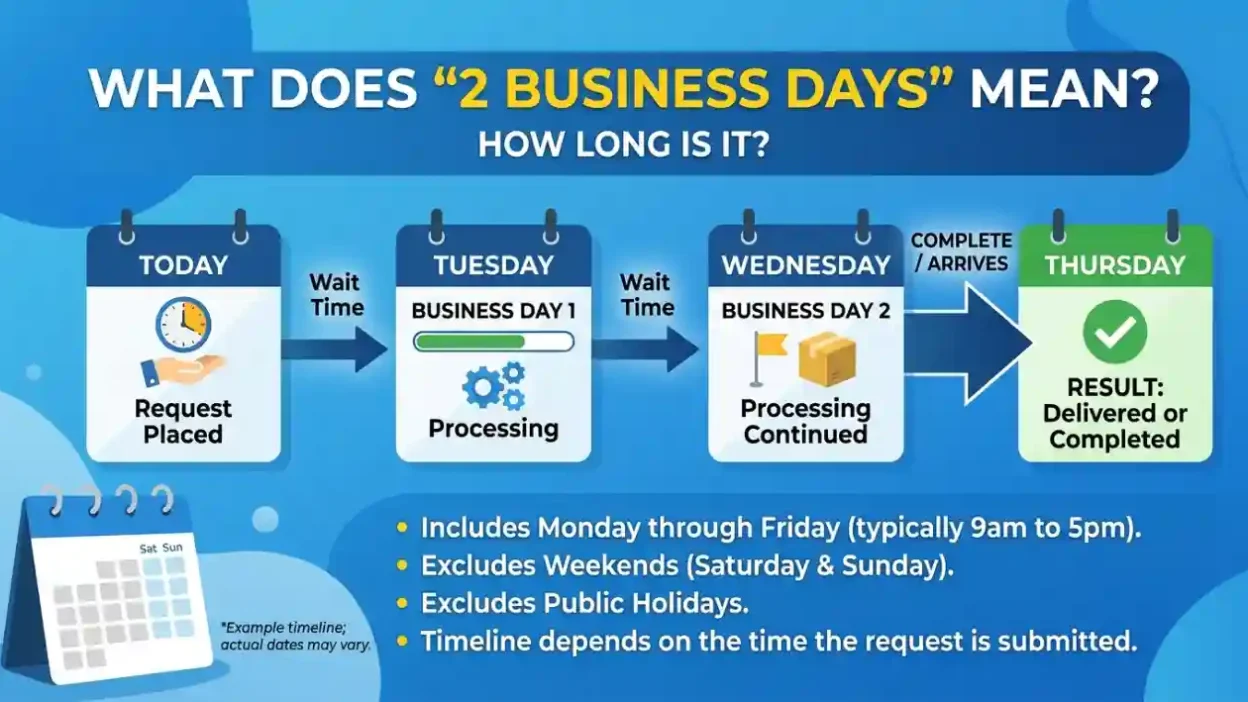
How long is 2 business days? Two business days usually means two working days, excluding weekends and applicable holidays. If a business operates Monday through Friday, an order placed on Monday may be processed by Wednesday, depending on its cutoff time. The exact deadline depends on the business’s policies and when the count begins.
Key Takeaways
- Two business days usually means two working days, most often Monday and Tuesday or Tuesday and Wednesday.
- Saturdays, Sundays, and applicable holidays generally do not count.
- A request made after a company’s cutoff time may start counting on the next business day.
- Two business days is not always the same as 48 consecutive hours.
- Shipping, banking, refunds, and customer service requests may follow different business-day rules.
How Long Is 2 Business Days?
Introduction
If you’ve ever ordered something online, requested a refund, or waited for an important email, you may have wondered, how long is 2 business days? The answer depends on when the count starts, which days the company considers working days, and whether a holiday falls within that period.
In most situations in the United States, two business days means two working days, usually Monday through Friday. Weekends and applicable public or company holidays typically do not count toward the total.
For example, if a company receives your request on Monday and begins counting that day, the second business day may be Tuesday. If counting starts on the next business day, the deadline may fall on Wednesday instead.
This guide explains how to calculate two business days, provides examples for different weekdays, and clarifies what the term means for shipping, banking, refunds, and customer service. You’ll also learn how to estimate a deadline without confusing business days with calendar days or hours.
What Does “How Long Is 2 Business Days” Mean?
The phrase refers to a period covering two business days rather than two ordinary calendar days. A business day is generally a day when a company or organization operates and processes its regular work.
For many US businesses, the standard business week runs from Monday through Friday. Saturday and Sunday are usually excluded, as are holidays when the organization is closed.
However, business-day rules can vary. A delivery company may operate on Saturdays, while a bank, government office, or online store may use a Monday-through-Friday schedule for processing requests.
For example, if a company starts counting on Tuesday, the two business days may be Tuesday and Wednesday. If it starts counting on Friday, the period may extend to Tuesday when the weekend is excluded and no holiday intervenes.
The most important detail is whether the company counts the day you submit your request or starts counting on the next business day.
Why Understand Other Ways to Express “2 Business Days”?
Understanding different ways to describe this time frame helps you interpret deadlines and communicate clearly with businesses. The wording may change, but the exact meaning can depend on the company’s policy.
Knowing the alternatives can help you:
- Avoid confusion: Understand whether a deadline includes weekends.
- Plan ahead: Estimate when a package, refund, or response might arrive.
- Communicate professionally: Ask for a specific completion date instead of relying on vague timing.
- Set realistic expectations: Recognize that processing time and delivery time may be different.
- Confirm deadlines: Find out whether the first day counts toward the total.
10 Best Other Ways to Say “2 Business Days”
Here are 10 useful alternatives to the phrase, with examples showing how people commonly use them in American English.
1. Two Working Days
Meaning
“Two working days” is a straightforward alternative to “two business days.” It generally refers to two days when an organization conducts its regular operations, excluding nonworking days.
Best For: Professional, Formal, Friendly
Example 1: Your application will be reviewed within two working days.
Example 2: Please allow two working days for our team to respond to your request.
Quick Tip: Use this phrase when explaining processing times or response deadlines. Confirm whether the organization follows a Monday-through-Friday schedule.
2. Within 48 Business Hours
Meaning
This phrase describes a time frame of up to 48 hours counted according to a business’s defined operating hours or processing rules. However, it is not a universal synonym for two business days because some organizations use different definitions.
Best For: Professional, Formal
Example 1: Our support team aims to reply within 48 business hours.
Example 2: You should receive an update within 48 business hours after your request is accepted.
Quick Tip: Use this wording only when the company defines business hours clearly. Forty-eight business hours can represent several calendar days if the company operates only eight hours per day.
3. By the End of the Second Business Day
Meaning
This phrase sets a deadline rather than simply describing a duration. It tells the reader to expect the task to be completed no later than the end of the second counted business day, subject to the stated starting point.
Best For: Professional, Formal
Example 1: Your replacement order should be dispatched by the end of the second business day.
Example 2: Please submit the missing documents by the end of the second business day after receiving this notice.
Quick Tip: Specify when counting begins, especially when the deadline involves payments, applications, or important documents.
4. Within Two Weekdays
Meaning
“Within two weekdays” generally means within two days that fall from Monday through Friday. It is a simple alternative, although it may be less precise when an organization observes holidays or uses a different work schedule.
Best For: Casual, Friendly
Example 1: Your confirmation email should arrive within two weekdays.
Example 2: We expect to review your profile within two weekdays of receiving your information.
Quick Tip: This wording works well for everyday communication. For formal deadlines, use “business days” and explain how holidays affect the schedule.
5. In Two Working Days
Meaning
“In two working days” communicates when someone expects an event to happen. It is commonly used in customer service, office communication, and delivery estimates.
Best For: Professional, Casual, Friendly
Example 1: Your account should be updated in two working days.
Example 2: The technician expects to send the inspection report in two working days.
Quick Tip: If the timing matters, ask whether “in two working days” means the second day itself or the completion of two full working days after submission.
6. Within Two Business Days of Receipt
Meaning
This expression connects the deadline to the date a company receives something. It is more precise than a general estimate because it identifies the event that starts the countdown.
Best For: Professional, Formal
Example 1: We will confirm your enrollment within two business days of receipt of your application.
Example 2: The claims department will contact you within two business days of receiving the required documents.
Quick Tip: Use this phrase for applications, claims, forms, and official correspondence. Make sure the receipt date is clear.
7. No Later Than Two Business Days
Meaning
This wording establishes an outer limit. It means the task should happen within the stated period, although it may be completed sooner.
Best For: Professional, Formal
Example 1: The vendor must provide a written update no later than two business days after the order is confirmed.
Example 2: We will notify you of the decision no later than two business days after the interview.
Quick Tip: This is useful when setting expectations or documenting a commitment. Include a clear starting date to prevent disagreements about the deadline.
8. By the Second Working Day
Meaning
“By the second working day” describes a deadline tied to the second qualifying working day. The exact date depends on whether the first day is included in the count.
Best For: Professional, Formal, Friendly
Example 1: The store expects to ship your item by the second working day after payment clears.
Example 2: Please send your feedback by the second working day following the meeting.
Quick Tip: State the starting event explicitly. This is particularly important when a request arrives late in the afternoon or before a holiday.
9. Within the Next Two Business Days
Meaning
This phrase refers to the upcoming two business days and is common in everyday updates. Depending on the context, readers may interpret it as starting with the next business day rather than the day the message was sent.
Best For: Casual, Friendly, Professional
Example 1: Our billing team will review the adjustment within the next two business days.
Example 2: You should receive a tracking update within the next two business days.
Quick Tip: Use this expression for general estimates. If the deadline is strict, replace “next two business days” with specific dates.
10. Within Two Business Days After Submission
Meaning
This expression identifies submission as the event that starts the expected time frame. It is useful when a company processes requests, forms, applications, or orders after receiving them.
Best For: Professional, Formal
Example 1: Your membership will be activated within two business days after submission of the completed form.
Example 2: We will review your return request within two business days after submission.
Quick Tip: Distinguish between submitting a request and having it accepted or received. Some systems do not begin processing until all required information is available.
Comparison Table
| Alternative | Best Used In | Tone |
|---|---|---|
| Two working days | General work and service updates | Neutral |
| Within 48 business hours | Support and processing estimates | Professional |
| By the end of the second business day | Firm deadlines | Formal |
| Within two weekdays | Everyday messages | Casual |
| In two working days | Delivery and status updates | Friendly |
| Within two business days of receipt | Applications and claims | Formal |
| No later than two business days | Commitments and agreements | Direct |
| By the second working day | Scheduling and follow-ups | Professional |
| Within the next two business days | Customer service updates | Conversational |
| Within two business days after submission | Forms and online requests | Precise |
Common Mistakes When Calculating Two Business Days
Avoid these five common errors when interpreting business-day deadlines.
1. Counting weekends automatically: Most businesses do not count Saturday and Sunday as business days. Always check the organization’s operating schedule.
2. Assuming the submission day always counts: A request submitted on Monday may start counting on Tuesday, depending on the company’s policy and cutoff time.
3. Confusing business days with 48 hours: Two business days are not necessarily 48 consecutive hours. Weekends, holidays, and operating schedules can extend the calendar time.
4. Ignoring holidays: A weekday holiday may delay processing, even when it falls within the expected time frame.
5. Treating estimates as guarantees: Shipping, banking, and refund estimates can change because of verification, delays, or additional processing requirements.
Frequently Asked Questions
1. How long is 2 business days in hours?
Two business days can represent 16 working hours if a business operates eight hours per day. However, two business days do not always equal 16 or 48 hours because companies use different schedules and counting rules.
2. Does 2 business days mean 48 hours?
No. Forty-eight consecutive hours include nights and weekends, while business days generally refer to working days. For example, a two-business-day period beginning on Friday may extend into Tuesday if Saturday and Sunday are excluded and Monday is a working day.
3. Do weekends count as business days?
Usually, no. Most US offices, banks, and businesses count Monday through Friday as business days. However, some retailers and service providers operate on weekends. Always check the specific organization’s policy before calculating a deadline.
4. If something takes 2 business days starting Monday, when is it due?
If Monday counts as the first business day, the second business day is Tuesday. If counting begins on the next business day after submission, the deadline may be Wednesday. The company’s cutoff time and processing policy determine which interpretation applies.
5. How long is 2 business days for shipping?
Two-business-day shipping generally refers to delivery within the carrier’s or seller’s defined business-day window. The delivery date may depend on the order cutoff time, weekends, holidays, and the service selected. Check the seller’s estimated delivery date for the most reliable answer.
6. Does the day I place an order count as the first business day?
Not always. An order placed before a seller’s daily cutoff may enter processing that day, while a later order may begin processing on the next business day. Some sellers count only after payment clears or the order is confirmed.
7. How do holidays affect two business days?
If a company closes for a holiday, that day generally does not count toward its business-day deadline. For example, if a holiday falls on Monday and a request starts counting on Friday, the second business day may be Tuesday, assuming the business is also closed on the weekend.
8. How can I calculate two business days from today?
Start with the date and time the business considers your request received. Count the qualifying business days, excluding weekends and applicable holidays. If you need an exact deadline, check the company’s cutoff time and whether the submission day counts.
Conclusion
Understanding how long is 2 business days helps you plan orders, refunds, applications, and other time-sensitive tasks. In most US business settings, the term means two working days, usually Monday through Friday, excluding applicable holidays.
The exact deadline depends on when counting begins. A request submitted on Monday might reach its second business day on Tuesday or Wednesday, depending on the organization’s rules. A request submitted on Friday may extend into the following week.
For everyday communication, phrases such as “two working days” and “within the next two business days” are easy to understand. For official deadlines, “within two business days of receipt” or “no later than two business days after submission” provides a clearer starting point.