When I first started learning about SEO vs AI Optimization, I thought I had to choose between traditional Google SEO and the newer world of AI search. With tools like ChatGPT, Google AI features, and other answer engines becoming part of everyday search, it is easy to wonder whether traditional SEO is becoming outdated.
The reality is different.
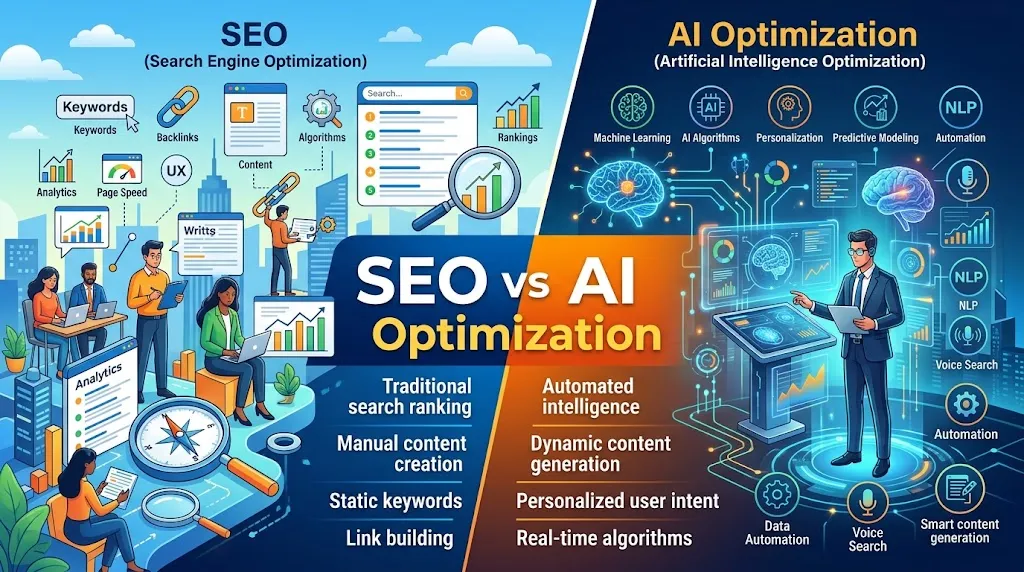
SEO and AI optimization are not replacements for each other. They are two connected approaches to making online content easier to discover, understand, and use. Traditional SEO helps search engines understand and rank your website, while AI-focused optimization helps your information become clearer and more useful for AI-powered search and answer experiences.
If you are building a website in 2026, understanding both approaches can help you create content that works for people, traditional search engines, and AI systems.
Quick Answer: SEO vs AI Optimization is the difference between optimizing content primarily for traditional search visibility and optimizing information so AI-powered systems can better understand, retrieve, summarize, and potentially surface it. The strongest strategy is usually to combine both.
What Is SEO?
SEO stands for Search Engine Optimization.
It is the process of improving a website and its content so search engines can understand its pages and show them for relevant searches.
SEO can include:
- Keyword research
- Search intent analysis
- Helpful content
- Title and heading optimization
- Internal linking
- Technical SEO
- Website speed
- Mobile usability
- Structured data
- Backlinks and authority
- Image optimization
- Crawlability and indexability
For example, imagine you have a website about running shoes and publish an article targeting best running shoes for beginners.
A traditional SEO strategy might involve researching the keyword, creating a useful title, optimizing headings, linking to related articles, improving page speed, and building authority around the topic.
The objective is to make the page competitive for relevant search queries.
What Is AI Optimization?
AI optimization is a broader and newer concept focused on making information easy for AI-powered systems to understand and use.
Instead of thinking only about where a webpage appears in a traditional search results page, you also consider how clearly your content communicates information to AI systems.
AI-friendly content generally benefits from:
- Clear explanations
- Direct answers
- Logical headings
- Well-organized information
- Strong topical coverage
- Accurate facts
- Relevant context
- Original insights
- Trustworthy sources
- Clearly defined entities and concepts
For example, instead of simply repeating the phrase best running shoes for beginners, an AI-aware article could explain:
- What makes a shoe beginner-friendly
- Which features matter most
- What type of runner each shoe suits
- Differences between shoe categories
- Common mistakes beginners make
- How to choose the correct size
- When a more expensive shoe is actually worthwhile
The goal is to provide information that is genuinely useful rather than simply repeating keywords.
SEO vs AI Optimization: What’s the Difference?
The easiest way to understand the difference is to look at their primary focus.
| SEO | AI Optimization |
|---|---|
| Focuses heavily on search visibility | Focuses on AI-driven discoverability and understanding |
| Targets search queries | Targets questions, concepts, and information needs |
| Uses keywords naturally | Uses natural language and contextual information |
| Optimizes technical website elements | Emphasizes clear and machine-understandable information |
| Builds search authority | Builds credibility and topical understanding |
| Competes for traditional search visibility | Seeks visibility across AI-powered experiences |
| Uses titles, links, headings, etc. | Uses clear answers, context, structure, and evidence |
There is significant overlap.
A technically healthy website with useful, authoritative content can potentially benefit from both traditional search and AI-driven discovery.
Is SEO Still Important in 2026?
Yes.
The growth of AI search does not make traditional SEO irrelevant.
Search engines still need to discover, crawl, understand, and evaluate web pages. Website owners therefore still need to pay attention to fundamentals such as:
- Crawlability
- Indexability
- Page experience
- Search intent
- Content quality
- Internal links
- Site architecture
- Relevant keywords
- Website authority
- Mobile usability
The important change is that search behavior is becoming more diverse.
People may search using Google, ask an AI assistant, use an AI-powered search engine, browse social platforms, or go directly to a trusted website.
This means website owners should think beyond one search results page.
How AI Is Changing Search Behavior
Traditional search often starts with a short keyword.
For example:
“best laptops under $1,000”
AI-powered search allows users to ask something much more specific:
“I need a laptop under $1,000 for university, light video editing, and gaming. What should I buy?”
The second question contains more context.
AI systems can potentially interpret the user’s requirements and produce a summarized response rather than simply returning a list of webpages.
This creates an important opportunity for publishers.
Instead of writing an article only around one keyword, create content that addresses the entire information need behind that keyword.
How to Optimize Content for Traditional SEO
A strong SEO strategy still starts with the basics.
1. Understand Search Intent
Before writing an article, determine what the user actually wants.
Are they looking for:
- Information?
- A comparison?
- A product?
- A tutorial?
- A definition?
- A review?
- A solution to a problem?
Matching intent is more useful than forcing a keyword into every paragraph.
2. Use Keywords Naturally
Keywords still help search engines understand the subject of a page.
However, avoid keyword stuffing.
Use the primary keyword in appropriate places such as:
- H1
- Introduction
- Relevant H2 headings
- Body content
- Meta title
- Meta description
- URL when appropriate
Then use related terminology naturally throughout the article.
3. Improve Internal Linking
Internal links help connect related pages.
For example, an SEO article could link naturally to:
- Keyword Research Guide
- Technical SEO Guide
- On-Page SEO
- Link Building
- Content Strategy
This helps users discover more information while also creating a clearer website structure.
4. Take Technical SEO Seriously
Even excellent content can have problems if search engines cannot properly access or understand the page.
Check:
- Robots.txt
- XML sitemap
- Canonical tags
- Indexing directives
- Broken links
- Redirects
- Mobile usability
- Page speed
- HTTPS
- Duplicate content
Technical SEO provides the foundation on which content visibility can grow.
How to Optimize Content for AI Search
AI optimization should not mean writing strange content specifically for machines.
Instead, make your information clear, complete, accurate, and easy to interpret.
1. Answer Questions Directly
If a user asks:
What is AI optimization?
Give the definition immediately.
Then explain the concept in more detail.
This structure makes your content easier for humans to scan and easier for automated systems to interpret.
2. Use Clear Headings
Organize your article around meaningful questions and topics.
For example:
- What is SEO?
- What is AI optimization?
- How are SEO and AI optimization different?
- Is SEO still important?
- How do I optimize content for AI search?
Clear structure improves readability and helps define relationships between different parts of the topic.
3. Cover the Topic Completely
Avoid creating a 1,500-word article that repeats the same idea.
Instead, identify the important questions surrounding the topic and answer them.
For a comparison article, discuss:
- Definitions
- Differences
- Similarities
- Advantages
- Limitations
- Examples
- Practical implementation
- Common mistakes
- Future considerations
4. Add Original Value
One of the best ways to make content more useful is to add something that cannot easily be copied from hundreds of generic articles.
You can include:
- Original examples
- Case studies
- Personal experience
- Data
- Screenshots
- Experiments
- Expert opinions
- Unique comparisons
- First-hand observations
This makes an article more valuable than generic content created by simply summarizing existing pages.
5. Support Important Claims
When making factual or technical claims, use trustworthy sources where appropriate.
Reliable supporting evidence can strengthen the credibility of your content.
SEO vs AI Optimization: Which One Should You Use?
You do not need to choose one.
Think of SEO as the foundation and AI-aware optimization as an additional layer.
A strong modern content workflow can look like this:
Step 1: Research the topic.
Step 2: Understand the user’s search intent.
Step 3: Identify important questions and subtopics.
Step 4: Create genuinely useful content.
Step 5: Optimize titles, headings, links, and technical elements.
Step 6: Give direct answers to important questions.
Step 7: Add original information and supporting evidence.
Step 8: Make the page easy to read and understand.
Step 9: Review the content for accuracy and unnecessary repetition.
Step 10: Monitor search performance and improve the page over time.
This approach avoids the false idea that SEO and AI optimization are competing strategies.
Common Mistakes to Avoid
❌ Keyword Stuffing
Repeating the same keyword dozens of times does not automatically make content better.
Use natural language.
❌ Writing Only for AI
Do not create awkward content simply because you think an AI system might read it.
Your primary audience is still people.
❌ Publishing Generic AI Content
AI tools can help with research, brainstorming, and drafting, but adding no original value can leave your content indistinguishable from thousands of other pages.
❌ Ignoring Technical SEO
A well-written article still needs to be crawlable and indexable.
❌ Chasing Every New AI Trend
AI search is evolving quickly.
Do not rebuild your entire website every time a new AI feature appears.
Focus on fundamentals that remain valuable: useful information, technical accessibility, accuracy, authority, and good user experience.
❌ Confusing AI Visibility With Guaranteed Rankings
Appearing in an AI-generated answer and ranking highly in traditional search are not necessarily the same thing.
Treat them as related but distinct discovery channels.
SEO vs AI Optimization Example
Imagine you run a website about personal finance.
You publish an article called:
How to Build an Emergency Fund
A traditional SEO approach might target searches such as:
- emergency fund
- how to build an emergency fund
- emergency savings
- how much emergency savings do I need
An AI-aware approach would also answer practical questions such as:
- How much should I save?
- Where should I keep the money?
- Should I pay off debt first?
- What counts as an emergency?
- How quickly should I build the fund?
- What if my income changes?
Now the article is not just targeting a phrase.
It is addressing the broader problem the user is trying to solve.
That is the real connection between SEO and AI optimization.
SEO vs AI Optimization for E-Commerce
E-commerce websites can benefit from both approaches.
A product page should clearly explain:
- Product name
- Features
- Benefits
- Specifications
- Size or compatibility
- Price information
- Use cases
- Frequently asked questions
- Shipping information
- Return information
Traditional SEO can help users discover the product through relevant searches.
Clear product information can also make it easier for automated systems to understand what the product actually is and who it is for.
For example, instead of writing:
Premium Running Shoes
provide meaningful information about:
Lightweight running shoes designed for beginner and intermediate runners, with cushioning for daily road running.
Specific information is more useful than vague marketing language.
SEO vs AI Optimization for Bloggers
Bloggers should avoid creating separate articles for every tiny variation of the same question.
Instead, build strong topical coverage.
For example, a website about fitness could create a central guide about beginner running and connect it to related articles about:
- Running shoes
- Beginner running plans
- Running injuries
- Warm-up exercises
- Recovery
- Running nutrition
This creates a stronger information network.
The goal is not simply to publish more pages.
The goal is to publish better-connected, genuinely useful information.
Does AI-Generated Content Hurt SEO?
Using AI does not automatically make content good or bad.
The bigger question is whether the final content is:
- Helpful
- Accurate
- Original
- Relevant
- Well researched
- Written for the audience
- Free from unnecessary repetition
AI can be useful for brainstorming, outlining, summarizing research, generating ideas, and improving drafts.
However, blindly publishing unedited AI-generated text can result in generic content that provides little additional value.
The human review process remains important.
What Is GEO?
GEO usually stands for Generative Engine Optimization.
The term is generally used when discussing optimization for generative AI search and answer experiences.
GEO overlaps with AI optimization, but the terminology is not always used consistently.
You may also encounter terms such as:
- AI Search Optimization
- AI Optimization
- Generative Engine Optimization
- Answer Engine Optimization
- Search Experience Optimization
These concepts overlap, but they can have different meanings depending on the author or platform.
For website owners, the exact label is less important than the underlying principle:
Create information that is useful, trustworthy, well structured, and easy to understand.
The Future of SEO and AI Optimization
Search is becoming more conversational and multimodal.
Users can increasingly discover information through:
- Traditional search
- AI assistants
- Voice interfaces
- Visual search
- Social platforms
- Shopping platforms
- Specialized search tools
This means website owners should avoid relying on a single traffic source.
The future of search optimization is likely to involve a combination of:
Technical accessibility + useful content + authority + structured information + strong user experience + AI-aware content strategy.
Rather than asking whether SEO is dead, a better question is:
How can my content remain discoverable wherever my audience searches?
SEO vs AI Optimization: Final Comparison
| Factor | SEO | AI Optimization |
|---|---|---|
| Main goal | Search visibility | AI-driven discoverability |
| Primary focus | Search engines | AI-powered systems |
| Keywords | Important | Useful but not sufficient |
| Search intent | Essential | Essential |
| Content structure | Important | Extremely important |
| Technical SEO | Essential | Still relevant |
| Authority | Important | Important |
| Direct answers | Helpful | Highly useful |
| Original insights | Valuable | Valuable |
| Internal links | Important | Helpful for context |
| Best approach | Optimize for search | Optimize information for understanding |
FAQs
1. What is the difference between SEO and AI optimization?
SEO primarily focuses on improving a website’s visibility in traditional search engines. AI optimization focuses on making information easier for AI-powered systems to understand and potentially surface in generated answers.
2. Is SEO still relevant in 2026?
Yes. Search engines remain an important way people discover websites. Technical SEO, useful content, search intent, authority, and website accessibility continue to matter.
3. Is AI optimization replacing SEO?
No. AI optimization should generally be viewed as an additional part of a modern content strategy rather than a complete replacement for SEO.
4. What is the best SEO strategy for 2026?
Focus on search intent, genuinely helpful content, strong site architecture, technical accessibility, internal linking, authority, and a good user experience.
5. How can I optimize my website for AI search?
Create clear, accurate, well-structured content. Answer important questions directly, provide context, cover topics thoroughly, demonstrate expertise, and support important claims with trustworthy evidence.
6. Should I stop using keywords because of AI search?
No. Keywords remain useful for understanding search demand and topic relevance. However, avoid keyword stuffing and focus on natural language and the user’s actual information needs.
7. Is GEO the same as AI optimization?
They overlap, but GEO usually refers more specifically to optimizing visibility in generative AI or answer-engine experiences.
8. Can AI-generated content rank in Google?
AI assistance does not automatically determine whether content performs well. What matters is the quality, usefulness, originality, accuracy, and overall value of the finished content.
9. Do backlinks still matter?
Authority and reputation remain important parts of search visibility. However, backlinks should be earned naturally through valuable content rather than pursued through manipulative tactics.
10. Should I optimize every article for AI?
You do not need a completely separate writing style for AI. Write useful content for humans first, then make the information clear, structured, accurate, and easy for automated systems to interpret.
Conclusion
The SEO vs AI Optimization debate is not really about choosing a winner.
Traditional SEO remains an important foundation for website discovery, while AI optimization reflects the growing role of AI-powered search and answer experiences.
The smartest strategy for 2026 is to combine the two.
Start with strong technical SEO. Understand search intent. Use keywords naturally. Build useful internal links. Create authoritative content. Answer questions clearly. Add original insights and trustworthy evidence. Most importantly, make every page genuinely useful to the person reading it.
Instead of trying to write for an algorithm, build content that people want to read and that machines can understand.
That approach gives your website a stronger foundation for both traditional search and the rapidly changing world of AI-powered discovery.