
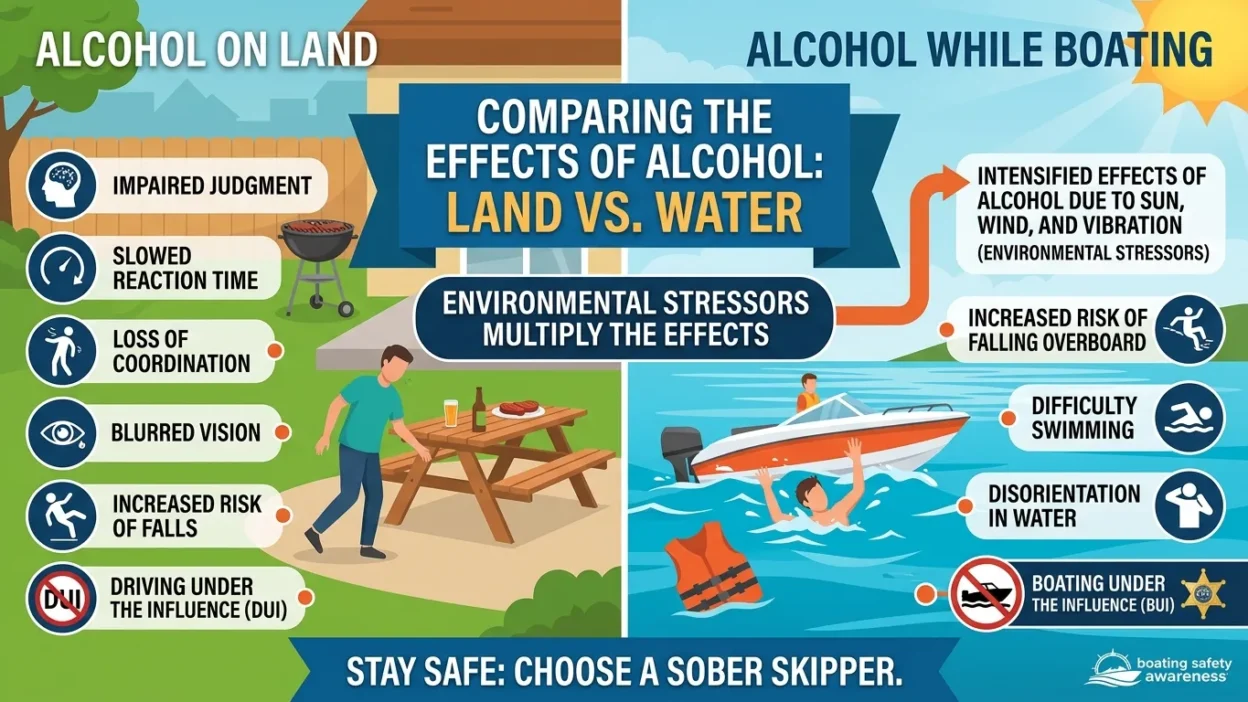
Ask most people whether it’s more dangerous to have a drink on a boat than at a backyard barbecue, and they’ll shrug. A drink is a drink, right? Wrong at least when it comes to how that drink actually affects you. While the alcohol itself doesn’t change, the environment it enters does, and that environment turns a manageable buzz on land into a serious safety hazard on the water.
This isn’t just a bar-talk claim. It’s backed by U.S. Coast Guard research, state boating agencies, and accident statistics that consistently point to the same conclusion: alcohol and boats are a far riskier combination than alcohol and dry land. This article breaks down exactly why that is the science, the stressors, the numbers, the laws, and what boaters can actually do about it.
The Core Science: BAC vs. Functional Impairment

Let’s clear up the most common misunderstanding first. Alcohol doesn’t metabolize any faster or differently just because you’re on a boat. Three beers produce the same blood alcohol concentration (BAC) whether you drink them at a marina or a kitchen table that part of the chemistry doesn’t change.
What changes is how that BAC translates into real-world impairment. You’ll often see the claim that one drink on a boat equals three drinks on land. That’s an oversimplification of the underlying chemistry, but it captures something true: the functional effect of a given BAC your coordination, judgment, and reaction time is measurably worse on a boat than it is at the same BAC on land. The number on a breathalyzer stays the same; how impaired you actually are does not.
Environmental Stressors Unique to Boating
The reason for that gap comes down to a set of physical stressors that simply don’t exist when you’re standing on solid ground:
Sun and heat exposure. Hours on open water mean hours of direct sun with little shade. That kind of heat exposure drives dehydration, and a dehydrated body processes and copes with alcohol far worse than a hydrated one.
Wind and engine noise. Constant wind resistance and the drone of an engine are physically draining in a way most people don’t register in the moment. It’s a slow drain on your reserves, and it’s happening before you’ve even opened a drink.
Motion and vibration. A boat is never still. Your muscles and inner ear are making constant, subconscious adjustments to keep you balanced on a moving, vibrating surface. Alcohol already interferes with the vestibular system responsible for balance layering boat motion on top of that multiplies the effect.
Glare and spray. Sunlight bouncing off open water causes glare that strains the eyes, and spray adds to the challenge of clear vision. Both compromise depth perception and focus critical skills when judging distance from docks, other vessels, or swimmers.
None of these factors is dangerous in isolation. The problem is that they don’t act independently they stack. By the time you factor in sun, wind, motion, and glare together, your body is already working overtime before alcohol enters the picture at all.
“Boater’s Hypnosis” (Boater’s Fatigue)

The Coast Guard has a specific term for the cumulative toll of these stressors: boater’s hypnosis, sometimes called boater’s fatigue. It describes the low-grade mental and physical exhaustion that builds after just a few hours on the water even for someone who hasn’t had a single drink.
Boater’s hypnosis on its own can slow reaction time to a degree comparable to actual intoxication. That’s the baseline. Add alcohol on top of an already-fatigued state, and the two don’t simply add together they compound. A drink that would barely register after a quiet afternoon at home can leave a boater lightheaded, unsteady, or seriously impaired after a few hours on the water, even at a BAC that would seem unremarkable on land.
Comparing Specific Impairment Domains
It helps to break down exactly which abilities take the biggest hit, since alcohol and boating stressors don’t affect every skill equally.
- Judgment and decision-making. Alcohol already impairs judgment on land. On the water, that impairment plays out in split-second decisions about speed, distance, and right-of-way mistakes with much higher stakes than a bad decision on a sidewalk.
- Balance and coordination. Standing steady on a moving deck is hard enough sober. Alcohol’s effect on coordination is magnified by a surface that’s actively shifting under your feet.
- Reaction time. Whether it’s another vessel appearing suddenly or a swimmer in the water, the margin for reaction time on the water is often smaller than on the road and alcohol widens the gap between a safe reaction and a fatal delay.
- Vision. Night vision, focus, and depth perception all suffer under alcohol’s influence, and glare or spray compounds each of those problems further.
- Thermoregulation and dehydration. Heat and sun exposure make it harder for the body to regulate temperature and stay hydrated both of which worsen how intoxication feels and functions in the body.
The Data and Statistics
The numbers make the risk concrete:
- Alcohol is consistently identified as a leading contributing factor in fatal boating accidents, showing up in roughly a fifth to a third of boating deaths depending on the year and region studied.
- A boat operator with a BAC above 0.10 is more than ten times more likely to be killed in a boating accident than one who hasn’t been drinking.
- Passengers face nearly the same level of risk as operators a notable finding, since it means the danger isn’t limited to whoever is behind the wheel.
- Most alcohol-related boating fatalities involve men between 21 and 40, most often in small open motorboats or non-powered craft.
Legal and Regulatory Landscape
Boating under the influence (BUI) is treated with the same seriousness as driving under the influence (DUI), and in many jurisdictions the legal BAC threshold for operating a vessel mirrors the 0.08% limit used for cars.
Penalties for a BUI conviction typically include steep fines, suspension or revocation of boating privileges, and in serious cases, jail time. The Coast Guard and state agencies have also ramped up enforcement in recent years, including sobriety checkpoints on popular waterways, mirroring the kind of enforcement long used on roads.
Debunking Popular Myths
With so much information circulating about alcohol and boating, a few myths are worth setting straight:
Myth: Alcohol chemically “hits harder” on a boat. Not quite. Your BAC from a given amount of alcohol is the same regardless of location. What’s different is how that BAC functions in a body already taxed by sun, motion, and fatigue.
Myth: Only the operator needs to worry. Research shows passengers face nearly identical risk to operators, including risks like falling overboard or being unable to react during an emergency.
Myth: A few hours in the sun doesn’t really affect intoxication. Dehydration from sun and heat exposure measurably worsens how alcohol affects the body, making this one of the more underestimated factors in boating impairment.
Practical Safety Recommendations
Given everything above, a few practical habits go a long way toward safer time on the water:
- Stay hydrated. Alternate alcoholic drinks with water to offset the dehydration that sun and wind are already causing.
- Designate a sober operator. Just as you would with a designated driver on land, make sure whoever is running the boat has had nothing to drink.
- Save drinking for after you dock. The simplest, most effective approach and the one the Coast Guard recommends outright is no alcohol at all while the boat is underway.
- Watch for early signs of boater’s fatigue. Unusual tiredness, slower reactions, or trouble concentrating can signal boater’s hypnosis setting in, alcohol or not.
- Take a boating safety course. These courses go beyond basic navigation rules, covering emergency handling and the specific ways alcohol impairs safe operation knowledge that builds real judgment on the water.
Conclusion
The chemistry of alcohol doesn’t change the moment you step onto a boat but nearly everything else does. Sun, wind, motion, noise, and fatigue combine to turn a manageable BAC into a much more dangerous level of real-world impairment.
Understanding that distinction isn’t just trivia for a boating exam; it’s the difference between a great day on the water and a preventable tragedy. Treat alcohol on a boat with at least the same caution you’d give it behind the wheel of a car arguably, given everything stacked against you on the water, even more.