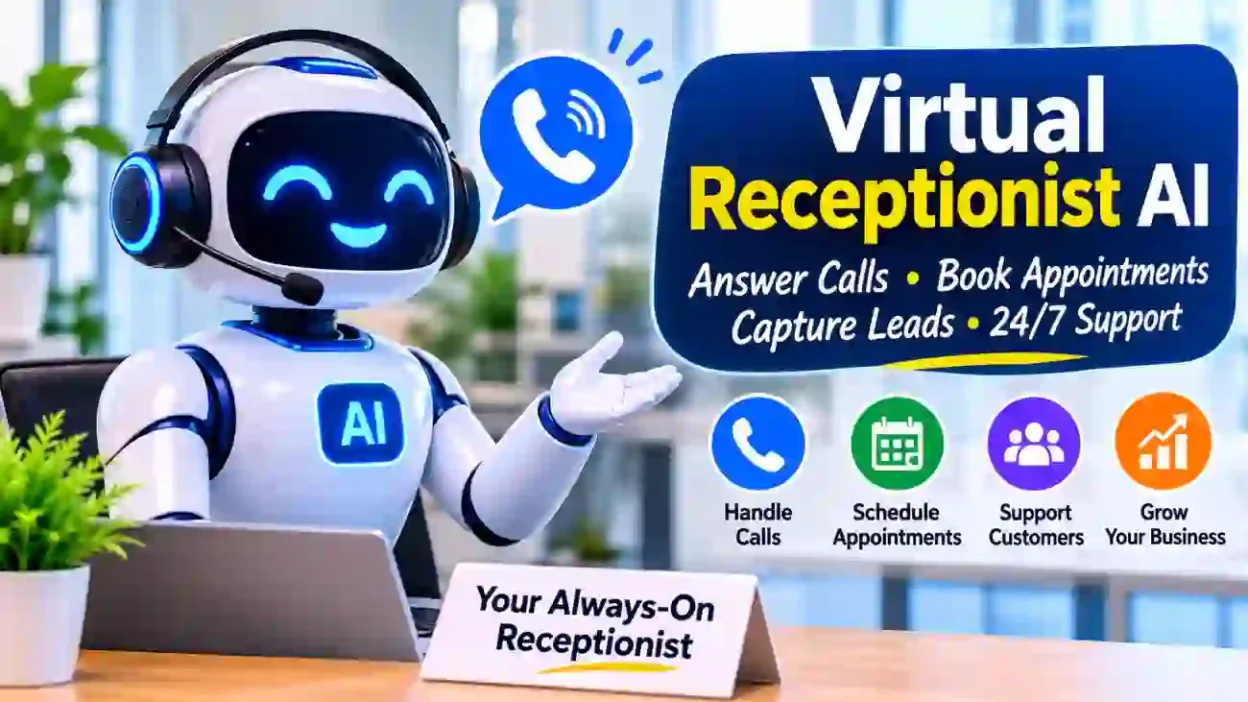
A virtual receptionist AI is an automated phone assistant that uses artificial intelligence to answer business calls, greet customers, schedule appointments, capture leads, and handle common questions. It helps businesses provide reliable phone support around the clock without hiring additional full-time reception staff.
Key Takeaways
- A virtual receptionist AI answers incoming business calls using artificial intelligence.
- It can handle customer questions, book appointments, and collect caller information.
- Small businesses can provide 24/7 phone support without maintaining a traditional front desk.
- AI receptionists can reduce missed calls and improve customer response times.
- Choosing the right system depends on features, pricing, integrations, and business needs.
Virtual Receptionist AI
Introduction
Missing a business call can mean losing a customer, appointment, or sales opportunity. However, many small businesses cannot afford to hire someone to answer every call throughout the day. This is where virtual receptionist AI can help.
A virtual receptionist AI uses artificial intelligence to answer phone calls, communicate with customers, and perform routine receptionist tasks. It can greet callers, respond to common questions, schedule appointments, and transfer calls to the right department.
Businesses across the United States are exploring this technology because it offers a flexible way to manage customer communication. Whether you run a medical office, home service company, law firm, or online business, an AI receptionist can help keep your phone lines active.
In this guide, you will learn how it works, why businesses use it, which features matter, and how to choose a suitable solution.
What Does “Virtual Receptionist AI” Mean?
Virtual receptionist AI refers to an artificial intelligence-powered system that performs receptionist duties through phone calls or other communication channels.
Unlike a traditional receptionist who answers calls manually, an AI receptionist uses voice recognition, natural language processing, and automated workflows to understand callers and respond to their requests.
For example, when someone calls a plumbing company, the AI receptionist can greet them, ask about their plumbing problem, collect their contact details, and schedule a service appointment.
Common uses include:
- Answering incoming phone calls.
- Greeting customers professionally.
- Scheduling and confirming appointments.
- Collecting customer information.
- Responding to frequently asked questions.
- Routing calls to employees.
- Taking messages after business hours.
- Capturing potential customer leads.
Businesses use these systems to improve phone availability and manage repetitive communication tasks.
Why Use a Virtual Receptionist AI?
Managing business calls can become difficult when employees are busy serving customers, completing appointments, or handling daily operations.
An AI receptionist helps reduce this pressure by managing routine calls automatically.
Here are some important benefits:
- Avoid missed calls: Answer incoming calls even when employees are unavailable.
- Save operating costs: Reduce the need for additional receptionist coverage.
- Improve customer experience: Give callers quick answers and clear instructions.
- Provide after-hours support: Keep business communication available outside normal working hours.
- Capture more leads: Collect contact information from potential customers.
- Reduce repetitive work: Let employees focus on tasks that require human attention.
- Handle busy periods: Manage multiple incoming calls according to the system’s capacity.
The biggest advantage is flexibility. Businesses can automate routine conversations while allowing employees to handle complicated requests.
10 Best Virtual Receptionist AI Features and Alternatives
Here are 10 useful AI receptionist capabilities and related service options that businesses should understand when evaluating solutions.
1. AI-Powered Call Answering
Meaning
AI-powered call answering allows an automated receptionist to answer incoming phone calls and communicate with callers. It uses voice technology to understand questions and provide relevant responses.
Best For:
Professional, Friendly, Polite
Example 1:
Our AI-powered call answering system handles incoming customer calls throughout the day.
Example 2:
Customers can reach our business even when our employees are helping other clients.
Quick Tip:
Choose a system that supports natural conversations instead of relying only on rigid recorded messages.
2. Automated Phone Receptionist
Meaning
An automated phone receptionist manages common receptionist duties without requiring someone to answer every call manually. It can greet callers, collect details, and direct conversations.
Best For:
Professional, Formal
Example 1:
Our automated phone receptionist directs customers to the appropriate department.
Example 2:
The company uses an automated receptionist to manage calls during busy periods.
Quick Tip:
Create a clear greeting that explains how callers can get the help they need.
3. AI Virtual Front Desk
Meaning
An AI virtual front desk provides digital receptionist services for businesses that want to manage customer interactions remotely. It can handle basic inquiries, appointment requests, and general information.
Best For:
Professional, Friendly
Example 1:
The dental clinic uses an AI virtual front desk to manage appointment requests.
Example 2:
Our virtual front desk welcomes callers and provides office information.
Quick Tip:
Make sure your system can answer questions about business hours, services, and locations.
4. Intelligent Call Management
Meaning
Intelligent call management uses AI to understand the reason behind incoming calls and direct them appropriately. It helps callers reach the right person without unnecessary transfers.
Best For:
Professional, Formal
Example 1:
Intelligent call management helps our support team organize incoming customer requests.
Example 2:
The system identifies sales inquiries and routes them to the sales department.
Quick Tip:
Set up clear call-routing rules for different customer needs.
5. AI Answering Service
Meaning
An AI answering service responds to incoming business calls when employees are unavailable. Depending on its features, it can answer questions, take messages, and capture important information.
Best For:
Professional, Polite
Example 1:
Our AI answering service collects customer messages after regular business hours.
Example 2:
The company uses an AI answering service to handle overflow calls.
Quick Tip:
Check whether the service can transfer urgent calls to a live employee.
6. Automated Appointment Scheduling
Meaning
Automated appointment scheduling allows an AI receptionist to book, confirm, or reschedule appointments. It can connect with supported calendars to check available time slots.
Best For:
Professional, Friendly
Example 1:
Patients can schedule dental appointments through our automated booking system.
Example 2:
Customers use the AI assistant to arrange service visits without waiting for an employee.
Quick Tip:
Connect the system to your actual business calendar to avoid scheduling conflicts.
7. AI Customer Support Assistant
Meaning
An AI customer support assistant helps businesses respond to common customer questions. It can provide information about services, policies, operating hours, and other frequently requested details.
Best For:
Friendly, Professional
Example 1:
Our AI customer support assistant answers basic questions about product delivery.
Example 2:
Customers can contact the virtual assistant for information before speaking with a support representative.
Quick Tip:
Regularly update the information the assistant uses so customers receive accurate answers.
8. Virtual Phone Assistant
Meaning
A virtual phone assistant manages business phone interactions using artificial intelligence. It can greet callers, understand requests, collect information, and complete supported tasks.
Best For:
Casual, Professional
Example 1:
Our virtual phone assistant helps customers find the information they need.
Example 2:
The company introduced a virtual assistant to manage routine phone conversations.
Quick Tip:
Test the assistant with different accents and speaking styles before making it available to customers.
9. 24/7 AI Receptionist Service
Meaning
A 24/7 AI receptionist service provides phone answering support at any time of the day or night. It helps businesses remain accessible when their physical offices are closed.
Best For:
Professional, Polite
Example 1:
Our 24/7 AI receptionist service answers customer calls during weekends and holidays.
Example 2:
Property managers use round-the-clock phone support to receive maintenance requests.
Quick Tip:
Establish clear procedures for emergencies and urgent customer requests.
10. AI Lead Capture Assistant
Meaning
An AI lead capture assistant collects information from people interested in a company’s products or services. It can ask qualifying questions and pass customer details to the sales team.
Best For:
Professional, Friendly
Example 1:
Our AI lead capture assistant collects contact details from potential customers.
Example 2:
The system records service inquiries so our sales team can follow up.
Quick Tip:
Ask only for information that your business needs to follow up with potential customers.
Comparison Table
| Alternative | Best Used In | Tone |
|---|---|---|
| AI-Powered Call Answering | Incoming calls | Professional |
| Automated Phone Receptionist | General business calls | Formal |
| AI Virtual Front Desk | Offices and clinics | Friendly |
| Intelligent Call Management | Large support teams | Professional |
| AI Answering Service | After-hours support | Polite |
| Automated Appointment Scheduling | Booking services | Friendly |
| AI Customer Support Assistant | Customer inquiries | Professional |
| Virtual Phone Assistant | Daily communication | Casual |
| 24/7 AI Receptionist Service | Round-the-clock support | Professional |
| AI Lead Capture Assistant | Sales and marketing | Friendly |
Common Mistakes When Choosing a Virtual Receptionist AI
Businesses sometimes select an AI receptionist based only on price or advertising claims. However, the wrong system can create communication problems.
Here are five mistakes to avoid.
1. Ignoring call quality: A system with unnatural speech or poor voice recognition can frustrate callers. Test actual conversations before choosing a provider.
2. Overlooking human support: Not every customer request can be handled automatically. Make sure callers can reach a real employee when necessary.
3. Choosing without checking integrations: Your receptionist should work with important business tools, such as calendars, CRM platforms, and phone systems.
4. Using outdated information: Incorrect business hours, pricing, or service details can confuse customers. Keep the AI’s knowledge and instructions updated.
5. Ignoring privacy and security: Phone conversations may contain personal information. Review data storage, access controls, retention policies, and applicable privacy requirements before activating the service.
Frequently Asked Questions
1. What is a virtual receptionist AI?
A virtual receptionist AI is software that uses artificial intelligence to handle receptionist tasks through phone calls or digital communication. It can answer customer questions, schedule appointments, collect contact details, and route calls. Businesses use it to improve customer communication without depending entirely on a traditional receptionist.
2. How does an AI virtual receptionist work?
An AI virtual receptionist receives an incoming call and converts the caller’s speech into information the system can understand. It processes the request using AI and responds with a generated voice. Depending on its setup, it can also access calendars, record messages, and transfer calls to employees.
3. Can an AI receptionist answer calls 24/7?
Yes. Many AI receptionist services operate around the clock, including weekends and holidays. They can answer calls when a business is closed or employees are unavailable. However, availability depends on the provider’s service terms, phone infrastructure, and system configuration.
4. How much does a virtual receptionist AI cost?
Pricing varies based on call volume, features, integrations, and the provider. Some services offer monthly subscription plans, while others charge according to usage or call minutes. Businesses should compare setup fees, overage charges, support costs, and contract terms before selecting a service.
5. Is an AI receptionist better than a human receptionist?
An AI receptionist can efficiently handle repetitive calls, basic questions, and appointment scheduling. A human receptionist offers personal judgment, empathy, and flexibility when conversations become complicated. Many businesses use both approaches, allowing AI to manage routine tasks while employees handle sensitive or complex situations.
6. Can AI receptionists schedule appointments?
Yes. Many AI receptionist platforms support appointment scheduling through calendar integrations. They can ask customers about their preferred times, check available slots, and book appointments. Some systems can also send confirmations and reminders through supported communication channels.
7. Which businesses can benefit from AI receptionists?
Medical offices, dental clinics, law firms, real estate agencies, plumbing companies, HVAC contractors, salons, and property management businesses can benefit from AI receptionists. These businesses often receive calls throughout the day and need a reliable way to manage appointments, customer questions, and service requests.
8. Is virtual receptionist AI worth it for small businesses?
It can be worthwhile for small businesses that receive regular calls but cannot afford full-time receptionist coverage. It helps reduce missed calls, manage routine inquiries, and capture potential leads. Before investing, compare the monthly cost with expected call volume, employee time savings, and the value of additional customer opportunities.
Conclusion
Virtual receptionist AI gives businesses a practical way to manage incoming calls, answer common questions, schedule appointments, and capture potential leads. It can support daily operations while reducing the pressure on employees who already have multiple responsibilities.
Choosing the right solution depends on your business size, customer needs, call volume, and budget. A small service company may benefit from automated call answering, while a medical office might need appointment scheduling and reliable call transfers.
Before selecting a provider, compare its features, pricing, integrations, security practices, and customer support. Test the system with real-world conversations to see how well it handles different requests.