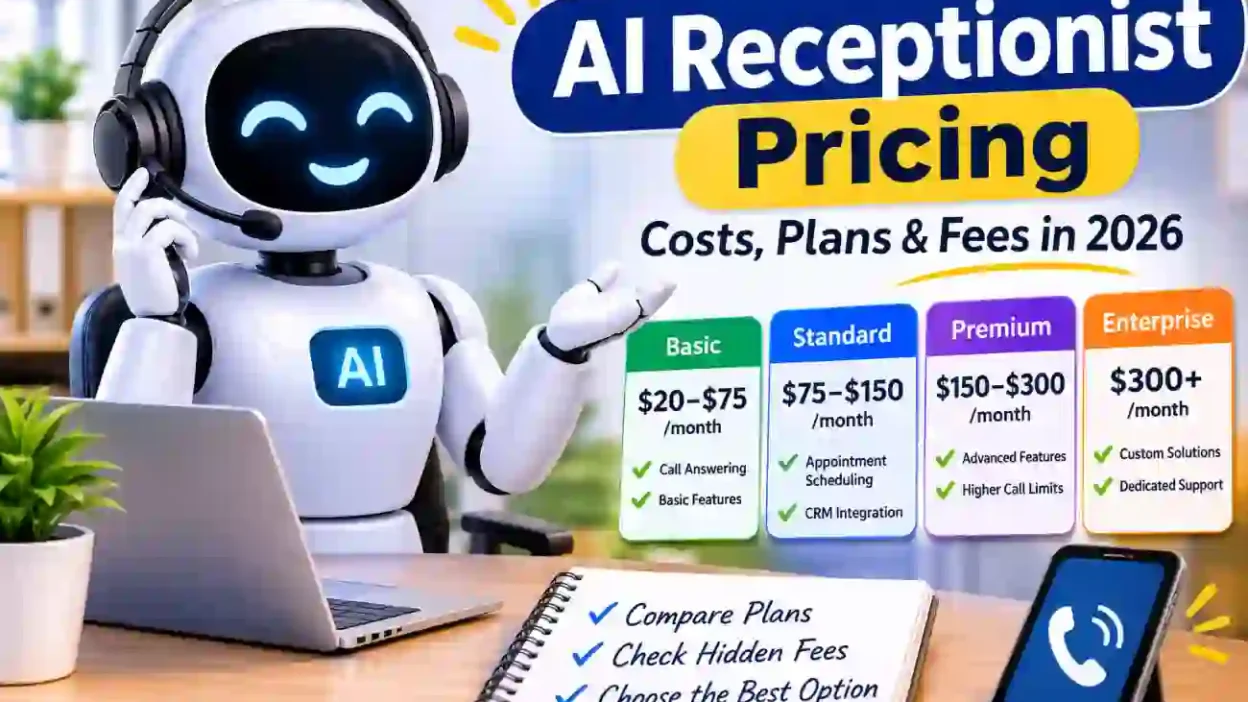
AI receptionist pricing typically ranges from $20 to $500+ per month, depending on call volume, features, integrations, and usage limits. Basic plans suit small businesses with low call traffic, while advanced plans offer custom workflows, CRM integrations, appointment scheduling, and higher call capacity.
Key Takeaways
- AI receptionist pricing depends on call volume, features, and the provider.
- Basic plans can work well for freelancers and small businesses.
- Usage-based plans charge according to minutes or calls handled.
- Advanced plans may include CRM integration, appointment booking, and custom workflows.
- Always check setup fees, overage charges, and contract terms before choosing a service.
ai receptionist pricing
Introduction
AI receptionist pricing is an important factor for businesses considering automated phone answering. Whether you run a small home service company, law office, medical practice, or online business, the right solution can help you manage customer calls without hiring a full-time receptionist.
However, not every AI receptionist costs the same. Some providers charge a flat monthly subscription, while others bill by the minute, call, or number of unique customers. Your actual cost depends on how many calls you receive and what tasks you expect the software to handle.
In this guide, we’ll explain typical AI receptionist costs in the United States, compare popular pricing models, explore real provider plans, and identify extra fees to watch for. You’ll also learn how to choose a plan that fits your budget without paying for features you don’t need.
What Does AI Receptionist Pricing Mean?
AI receptionist pricing refers to the amount a business pays for software that answers phone calls and handles routine receptionist tasks using artificial intelligence.
Depending on the provider, the service may answer customer questions, collect contact details, qualify leads, schedule appointments, transfer calls, and send follow-up messages.
Most services offer monthly subscriptions with specific usage limits. Some also provide pay-as-you-go options for businesses that prefer to pay only for the calls or minutes they use.
AI receptionist services are commonly used by:
- Small businesses and startups.
- Medical and dental offices.
- Real estate agencies.
- Law firms.
- Contractors and home service companies.
- Restaurants and appointment-based businesses.
- Customer support and sales teams.
How Much Does an AI Receptionist Cost in 2026?
In the United States, many AI receptionist plans cost approximately $20 to $300 per month. More advanced business solutions can cost $500 or more, especially when they include custom workflows, higher call limits, and dedicated support.
Here is a general pricing breakdown:
| Pricing Level | Typical Monthly Cost | Suitable For |
|---|---|---|
| Free or trial plans | $0 | Testing and low-volume use |
| Basic plans | $20–$75 | Freelancers and startups |
| Standard plans | $75–$150 | Small businesses |
| Advanced plans | $150–$300 | Growing companies |
| Enterprise plans | $300–$500+ | Larger organizations |
These are general budgeting ranges, not guaranteed market-wide prices. Actual plans and usage charges vary by provider.
A low monthly price does not always mean a lower total bill. Check the included minutes, calls, customer limits, and overage rates before comparing providers.
10 Popular AI Receptionist Pricing Options
The following providers illustrate different ways businesses can purchase AI receptionist services. Prices are published plan examples, not endorsements, and may change.
1. Smith.ai AI Receptionist
Smith.ai offers AI-powered call answering with options for lead qualification, call routing, scheduling, and integrations.
Its published pricing includes:
- Free: $0 per month for 25 calls.
- Pro: $150 per month for 75 calls.
- Enterprise: $500 per month for 300 calls.
Additional calls have separate charges, depending on the plan. The service also offers higher-volume options and custom enterprise arrangements.
Best for:
Businesses that need call screening, lead qualification, and more advanced call handling. smith.ai+1
2. Dialzara
Dialzara uses a minute-based pricing structure. This makes it useful for businesses that want to estimate costs based on their expected phone activity.
Published plans include:
- Lite: $29 per month for 60 minutes.
- Pro: $99 per month for 220 minutes.
- Plus: $199 per month for 500 minutes.
- Elite: $349 per month for 1,000 minutes.
Additional minutes are charged according to the selected plan.
Best for:
Small businesses that want different monthly minute allowances. Rample.ai+1
3. Goodcall
Goodcall uses a unique-customer pricing model rather than relying only on call duration.
Its published plans include:
- Starter: $79 per month for 100 unique customers.
- Growth: $129 per month for 500 unique customers.
- Scale: $299 per month for 2,000 unique customers.
Additional customer charges depend on the selected tier.
Best for:
Businesses that receive repeat calls from an established customer base. TradesReceptionist+1
4. Rosie
Rosie offers monthly plans with included call minutes. Businesses can choose a tier based on their expected phone traffic.
Published pricing includes:
- Professional: $49 per month for 250 minutes.
- Scale: $149 per month for 1,000 minutes.
- Growth: $299 per month for 2,000 minutes.
Best for:
Small companies that want straightforward monthly minute packages. Rample.ai+1
5. My AI Front Desk
My AI Front Desk combines AI phone answering with other business communication tools.
Its published Business-in-a-Box plan costs $99 per month, or $79 per month when billed annually. The plan includes 200 voice minutes, along with chat, SMS, and CRM features.
Best for:
Businesses looking for phone answering and customer communication features in one platform. Rample.ai+1
6. Upfirst
Upfirst offers plans based on the number of calls handled each month.
Its published entry-level pricing starts at $24.95 per month for 30 calls. Higher plans provide larger call allowances, making it possible to choose a package based on business demand.
Best for:
Freelancers and small businesses with predictable call volumes. Rample.ai+1
7. RingCentral AI Receptionist
RingCentral offers an AI receptionist option for businesses that want automated phone answering within a broader business communications environment.
A published standalone price is $49 per month, including 100 minutes. Additional usage is charged separately.
Best for:
Businesses already using business phone and communication tools. Rample.ai+1
8. Retell AI
Retell AI follows a usage-based approach for businesses building AI voice agents.
Instead of choosing only a traditional receptionist subscription, businesses can build customized voice experiences and pay according to usage and selected services.
Best for:
Developers and companies that want more control over their AI phone workflows.
9. OnCrew
OnCrew provides AI receptionist options aimed at service-based businesses.
Its published pricing includes a Starter plan at $49 per month, with 100 calls, and higher tiers for businesses with greater call requirements.
Best for:
Contractors and home service companies that need automated customer call handling. TradesReceptionist+1
10. Custom Enterprise AI Receptionist Plans
Some providers offer custom pricing instead of displaying a fixed monthly subscription.
These plans may include advanced integrations, multiple phone numbers, custom AI training, dedicated support, and specialized call workflows. The final price depends on business requirements and expected usage.
Best for:
Large companies, multi-location businesses, and organizations with complex customer service needs.
AI Receptionist Pricing Models Explained
Understanding how providers calculate their fees can help you avoid unexpected expenses. Most AI receptionist services use one of the following pricing models.
1. Monthly Subscription Pricing
You pay a fixed amount every month for access to the service. Your subscription usually includes a set number of calls, minutes, or other features.
This model works well when your monthly phone activity stays fairly consistent.
2. Per-Minute Pricing
The provider charges according to how long the AI spends handling calls. For example, a plan might include 200 minutes, with additional charges for every minute beyond that allowance.
This option can suit businesses that receive calls of different lengths.
3. Per-Call Pricing
You pay a specific amount for each completed or handled call. Some providers include a certain number of calls in their monthly plans.
This approach makes budgeting easier when your call volume is predictable. However, frequent short calls can increase your total expense.
4. Per-Customer Pricing
Some platforms charge based on the number of unique customers who contact your business during a billing period.
This model can be useful when existing customers call repeatedly, although businesses attracting many new callers should check the additional customer fees.
5. Custom Enterprise Pricing
Enterprise plans are designed for organizations with advanced requirements. Providers may calculate costs based on locations, phone numbers, integrations, usage, and customization.
Always request a written quote that explains recurring fees and additional charges.
What Factors Affect AI Receptionist Pricing?
Several factors determine how much you’ll pay for an AI receptionist.
- Monthly call volume: More calls usually require a larger plan or additional usage payments.
- Call duration: Longer conversations can increase costs on minute-based plans.
- Features: Appointment booking, lead qualification, call transfers, and CRM integrations may affect pricing.
- Customization: Custom greetings, industry-specific scripts, and advanced workflows may require higher-tier plans.
- Business locations: Companies managing multiple offices or phone numbers may need additional subscriptions.
- Customer support: Dedicated onboarding and priority assistance can increase the monthly cost.
- Language support: Multilingual call handling may be included or offered as an additional feature.
Before purchasing, estimate your average monthly calls and call duration. This gives you a more realistic idea of which plan will fit your business.
Hidden Costs to Check Before Buying
The advertised subscription price is only one part of your total expense. Review these possible additional charges:
- Setup fees: Some providers charge for onboarding, configuration, or custom AI training.
- Extra minutes: Calls beyond your monthly allowance may create overage charges.
- Additional phone numbers: Multiple business lines may require extra payments.
- CRM integrations: Certain advanced integrations may require a higher subscription.
- SMS charges: Text confirmations and follow-up messages may use separate credits.
- Phone forwarding: Your existing carrier may charge for call forwarding or related services.
- Contract fees: Check cancellation policies, annual billing conditions, and minimum commitments.
Not every provider charges these fees. Ask for a complete pricing breakdown before connecting the service to your business phone number.
How to Choose the Right AI Receptionist Pricing Plan
The right plan depends on your call volume, business size, and customer service needs.
Use these steps to make a practical decision:
1. Estimate your monthly calls. Review your phone records to understand how many calls you receive during a typical month.
2. Calculate average call duration. A business receiving 100 calls lasting two minutes each needs a different allowance from one receiving 100 calls lasting eight minutes.
3. Identify essential features. Decide whether you need basic answering, appointment scheduling, lead collection, call transfers, or CRM integration.
4. Compare billing methods. Calculate the estimated total cost under per-minute, per-call, and monthly subscription plans.
5. Test the service. Use a free trial or demo to check voice quality, response accuracy, and call handling.
6. Review the cancellation policy. Make sure you understand billing dates, renewal terms, and contract requirements.
A good pricing decision considers both the monthly subscription and the value of the calls the service handles.
Common Mistakes When Comparing AI Receptionist Costs
Avoid these five mistakes when evaluating different providers.
- Choosing the cheapest plan automatically: A low starting price may come with limited minutes or expensive overage charges.
- Ignoring usage limits: Your actual monthly bill can increase if you regularly exceed included calls or minutes.
- Paying for unnecessary features: Advanced integrations and custom workflows may not benefit every small business.
- Overlooking call quality: A low-cost system is not useful if it misunderstands customers or transfers calls incorrectly.
- Ignoring support and cancellation terms: Poor onboarding or restrictive contracts can create problems later.
Compare the complete service rather than focusing only on the advertised monthly price.
Frequently Asked Questions
1. How much does an AI receptionist cost per month?
An AI receptionist commonly costs around $20 to $300 per month for standard small-business plans. Some providers offer free entry options, while advanced enterprise services can exceed $500 monthly. Your final cost depends on included calls, minutes, features, and additional usage fees.
2. Is there a free AI receptionist?
Yes. Some providers offer free plans, limited trials, or free demonstrations. For example, Smith.ai publishes a free AI receptionist option that includes 25 calls per month. Check the usage limits and additional call charges before relying on a free plan for daily business operations. smith.ai
3. Is an AI receptionist cheaper than a human receptionist?
An AI receptionist is generally less expensive than hiring a full-time employee because it does not require a traditional salary, employee benefits, or paid leave. However, the comparison depends on business needs, call volume, software costs, and whether human assistance is still required for complex calls.
4. Do AI receptionists charge per call or per minute?
Both pricing methods are available. Some providers charge a fixed amount for every handled call, while others calculate fees based on call duration. Other platforms use monthly subscriptions or unique-customer limits. Always check how the provider defines a billable call or minute.
5. What is the cheapest AI receptionist for small businesses?
Entry-level options include Upfirst at $24.95 per month, Dialzara at $29 per month, and Rosie at $49 per month based on their published plans. However, the cheapest option for your business depends on included usage, extra charges, and required features. Rample.ai+1
6. Does AI receptionist software have setup fees?
Some providers include setup and onboarding in their subscriptions, while others may charge for custom configuration or implementation. Costs depend on the complexity of your phone system and integrations. Ask whether training, phone number configuration, and workflow setup are included.
7. Can I use an AI receptionist for a small business?
Yes. AI receptionists can help small businesses answer calls, collect customer information, schedule appointments, and route inquiries. They are particularly useful for owners who cannot answer every call while working. Choose a plan that matches your actual monthly phone activity.
8. What should I look for in an AI receptionist pricing plan?
Look at monthly fees, included call minutes, usage limits, overage rates, integrations, appointment scheduling, and customer support. Also review cancellation terms and phone charges. The best plan is one that handles your essential tasks reliably without creating unexpected expenses.
Conclusion
AI receptionist pricing varies based on the provider, billing method, monthly call volume, and available features.
Small businesses can start with affordable plans, while growing companies may benefit from advanced subscriptions with CRM integrations, appointment scheduling, and custom call workflows.
Before choosing a service, compare more than the advertised monthly fee. Check included minutes, extra call charges, setup costs, customer support, and cancellation policies.