There’s a specific kind of satisfaction that comes from Little Alchemy 2 that little spark when two unrelated elements combine into something you didn’t expect. Combine Fire and Water and you get Steam.
Combine Human and Idea and, eventually, you get Philosophy. It’s a game built entirely around curiosity, and few elements reward that curiosity better than Big.
Big isn’t flashy. It won’t announce itself as a “final boss” element the way Life or Human might feel like milestones. But it quietly sits behind dozens of other discoveries boulders, giant creatures, oversized structures waiting for you to unlock it.
If you’ve been wondering how to make Big in Little Alchemy 2, this guide walks through everything: the exact recipes, the full prerequisite chains, common mistakes to avoid, and what Big unlocks once you have it.
What Is the Big Element?
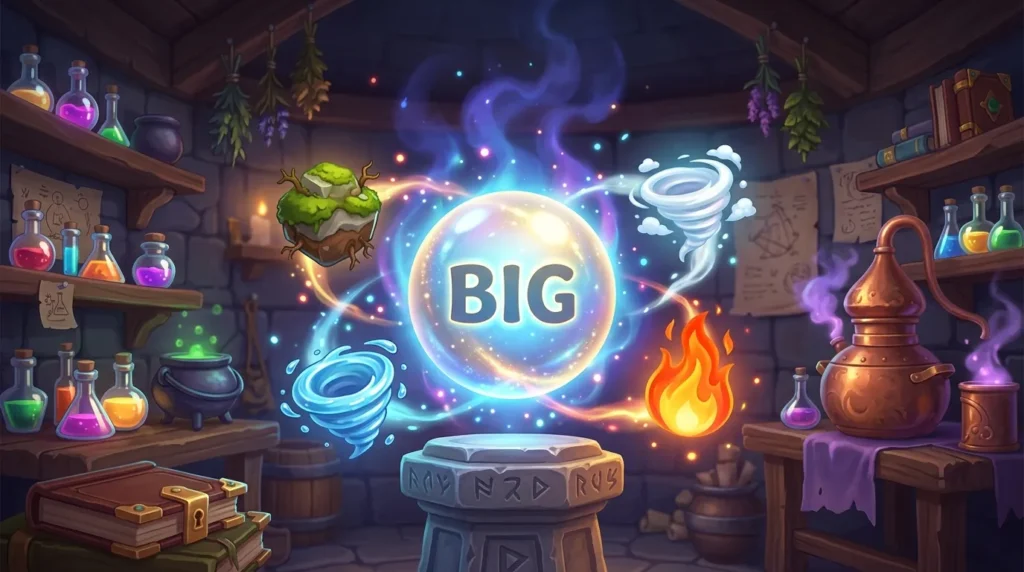
In Little Alchemy 2, Big isn’t a physical object you can point to — it’s a modifier. Think of it as a concept the game layers onto other elements to change their scale. It has been described as “when Small grows up,” which sums up its role nicely: Big takes existing ideas and makes them larger, grander, or more extreme versions of themselves.
Because it’s a modifier rather than a standalone item, Big tends to show up in the mid-to-late stages of a typical playthrough. You won’t stumble into it accidentally the way you might with Steam or Mud — it requires building up a small chain of prerequisite elements first. Once unlocked, though, it becomes one of the more productive elements in your inventory: roughly 46 elements in the base game use Big as an ingredient, spanning categories like geography, animals, mythical beings, and man-made structures.
All Recipes for Big (Complete List)
The defining feature of every Big recipe is that they all require Philosophy. From there, you pair Philosophy with a celestial object. Here’s the full list:
- Philosophy + Planet = Big (most common/easiest)
- Philosophy + Sun = Big
- Philosophy + Solar System = Big
- Philosophy + Galaxy = Big
- Philosophy + Galaxy Cluster = Big
- Philosophy + Universe = Big
Since Philosophy is a fixed requirement across every version of this recipe, your choice really comes down to whichever celestial object you already have — or whichever is fastest for you to reach. For most players, Planet is the quickest of the six, since it doesn’t require building out the entire space-element tree.
| If you already have… | Combine with Philosophy | Notes |
| Planet | Philosophy + Planet | Fastest overall path |
| Sun | Philosophy + Sun | Good if you built Sun for other recipes |
| Solar System | Philosophy + Solar System | Requires more space-tree progress |
| Galaxy | Philosophy + Galaxy | Later-game element |
| Galaxy Cluster | Philosophy + Galaxy Cluster | Later-game element |
| Universe | Philosophy + Universe | Deepest into the space tree |
Prerequisite Deep Dive: How to Make Philosophy
Philosophy is the real bottleneck here — it takes more steps to reach than any celestial object does, so most of your effort goes into this chain.
Building Up From the Four Base Elements
Starting from Air, Earth, Fire, and Water, work through the following combinations:
- Air + Air = Pressure
- Water + Earth = Mud
- Earth + Pressure = Stone
- Water + Water = Puddle
- Water + Puddle = Pond
- Water + Pond = Lake
- Water + Lake = Sea
- Earth + Fire = Lava
- Earth + Lava = Volcano
- Lava + Sea = Primordial Soup
- Mud + Stone = Clay
Getting to Life, Then Human
- Primordial Soup + Volcano = Life
- Life + Clay = Human
Building the Second Ingredient: Idea
Human alone won’t get you Philosophy — you also need Idea. The most direct route is:
- Human + Light Bulb = Idea
If you haven’t unlocked Light Bulb yet, a few exclusionarypaths also produce Idea:
- Light Bulb + Engineer = Idea
- Light Bulb + Science = Idea
- Science + Science = Idea
The Final Combination
- Human + Idea = Philosophy
Little Alchemy 2 also offers a couple of alternate Philosophy recipes if you happen to unlock their ingredients first:
- Human + Story = Philosophy
- Egg + Chicken = Philosophy
And interestingly, Philosophy also auto-unlocks once you’ve crafted 150 total elements in the game so if you’re a completionist exploring broadly rather than following a guide, there’s a good chance you’ll get it “for free” along the way.
Prerequisite Deep Dive: How to Make a Celestial Object
The good news is that the celestial half of the Big recipe is much shorter than the Philosophy half especially if you go the Planet route.
The Fastest Path: Planet
- Earth + Earth = Land
- Earth + Land = Continent
- Continent + Continent = Planet
That’s it — just three steps from a single base element, with no need to touch the sky/space branch at all. Little Alchemy 2 does offer other ways to reach Planet (Earth + Sky, Earth + Space, Continent + Ocean), but the Land → Continent → Planet path is generally the shortest.
If You’d Rather Go a Different Route
If you’re already deep into the sky/space branch and have Sun, Solar System, Galaxy, Galaxy Cluster, or Universe on hand, feel free to use whichever you’ve already got — any of them completes the Big recipe just as well as Planet does.
Tip: Since the Philosophy chain and the Planet chain share almost no overlapping ingredients, there’s no real reason to do them strictly in order. Building both branches side by side (a little Philosophy progress, a little Planet progress) can save you some mental backtracking.
Step-by-Step Walkthrough (Quick Reference)
If you just want the full path in one place, here it is start to finish:
- Air + Air = Pressure
- Water + Earth = Mud
- Earth + Pressure = Stone
- Water + Water = Puddle
- Water + Puddle = Pond
- Water + Pond = Lake
- Water + Lake = Sea
- Earth + Fire = Lava
- Earth + Lava = Volcano
- Lava + Sea = Primordial Soup
- Mud + Stone = Clay
- Primordial Soup + Volcano = Life
- Life + Clay = Human
- Human + Light Bulb = Idea
- Human + Idea = Philosophy
- Earth + Earth = Land
- Earth + Land = Continent
- Continent + Continent = Planet
- Philosophy + Planet = Big
Eighteen steps to set up, one final combination to pay it off.
Common Mistakes and Misconceptions
- Chasing Time first. A lot of players assume Time is somehow required to make Big, since it feels like a “modifier” element too. It isn’t part of any Big recipe don’t waste moves unlocking it just for this.
- Confusing Big with Giant or other size-related terms. Little Alchemy 2 has more than one size-adjacent element as you go deeper into the game. Big specifically is the Philosophy + celestial object combination described above.
- Expecting a direct shortcut like Human + Human. It’s tempting to think doubling up an element (Human + Human, House + House) should produce Big directly, since it “feels” bigger. It doesn’t the only guaranteed recipes run through Philosophy.
- Losing track of the Philosophy chain. Because it has so many steps, it’s easy to forget where you left off. If you get lost, work backward from Human + Idea and rebuild whichever branch you’re missing.
What You Can Make With Big
Once Big is unlocked, it opens the door to roughly 46 other elements. Broadly, they fall into a few categories:
- Nature and geography — things like boulders and oceans, where a normal-sized element gets scaled up into something more dramatic.
- Animals — oversized or exaggerated versions of creatures you’ve already discovered.
- Mythical and legendary beings — Big is a common ingredient in the recipes for giants and other larger-than-life figures.
- Structures and civilization — bigger buildings, cities, and man-made elements that build on your earlier House/City-style discoveries.
Some of these unlocks feed directly into further progression, so Big is worth prioritizing if you’re trying to push into the game’s more advanced content — including some elements exclusive to the Myths and Monsters pack.
Tips for Efficient Progress
- Use the hint system strategically. Little Alchemy 2’s built-in hints nudge you toward the next logical combination without spelling out the full answer — useful if you want to stay in “discovery mode” rather than following a guide step-by-step.
- Prioritize dual-purpose elements. Many of the ingredients in the Philosophy chain (like Stone, Lava, or Human) are used in dozens of other recipes too, so building them isn’t wasted effort even outside the Big chain.
- Build in parallel. As mentioned above, working on Philosophy and Planet side by side avoids the feeling of “starting over” partway through.
- Don’t over-plan. Little Alchemy 2 rewards exploration. If you stumble onto Philosophy or Planet naturally while experimenting, you may reach Big well before you expect to.
FAQs:
Is Big required to finish the game?
There’s no strict “finish line” in Little Alchemy 2, but Big is one of the more productive elements to unlock, since so many other combinations depend on it.
What’s the fastest way to make Big from scratch?
Philosophy + Planet, using the Land → Continent → Planet shortcut for the celestial half.
Does Big appear differently in the Myths and Monsters pack?
The core recipe stays the same; the pack simply adds extra elements that use Big as an ingredient once you own it.
Can Big be combined with itself or with Small?
Big is primarily used as an ingredient for other elements rather than combined with itself, and it does not combine directly with Small to produce anything new.
Is there a way to unlock Big without Philosophy?
No — every known recipe for Big requires Philosophy paired with a celestial object.
Conclusion
Making Big in Little Alchemy 2 boils down to one core equation Philosophy + Planet but getting there means working through two separate ingredient chains: the long, winding path to Philosophy, and the short, three-step path to Planet.
Once you’ve made the trip, though, Big pays for itself many times over, unlocking dozens of new elements across animals, structures, and mythical beings.
If you enjoyed this guide, you might also want to check out how to make Philosophy on its own, how to make Small (Big’s natural counterpart), and how to build out the rest of the Planet/space element tree.